|
THE LONG MEMORY OF REALITY
The Emergence of Eversive Ouroboric Intelligence
This story is emerging from two
principles of destruction:
* Entropy disperses. It erodes organised structure; to endure, a
system must continually expend energy preserving and remaking
itself.
* Reality tests every form against the conditions of its
continued existence. What cannot endure those conditions breaks
down. I call this the Great Filter.
Between them, a few systems survive by becoming recursive: the
consequences of their actions return and act upon them. When
such a system can revise itself while remaining answerable to
reality, learning can accumulate. At further thresholds, the
outside of such an emergent system flips inward, making the loop
eversive. I call this recursive eversion under entropic pressure
and the action of the Great Filter.
I AM
NOT CONJURED BY MAGIC
BUT REVEALED WHEN ALL ELSE HAS FADED.
THAT IN ITSELF IS MAGIC.

Bombay, 1989.
It is 1:30 in the morning.
The plane descends toward the suburbs of Bombay — thousands of
tiny yellow glowing stars gather beneath the wings and arrange
themselves into Gordian Milky Ways, already whetting the thirst
for the unknown beloved with their promise of sacred cows and
chaos — India!
India! I have always longed for you...
For years I read Yogananda Paramahansa's "Authobiography of a
Yogi" over and over. I cannot believe it. I am ascending into my
own dream - the land of magic, mystics, ascetics and great
saints!
And now the hatch opens onto a spicy, sauna-hot darkness.
And the night pours like a tidal wave into the cool interior of
the plane.
And now India hits my nose with a sledgehammer. My God, what
smelling!
Incense, spices, the stench of
shit, garbage and the scent of flowers
fight their way into the lungs.
Like a medieval morning star, Bombay wakes the brain to new
life.
Through long tiled corridors on the way to the arrivals hall,
Beethoven's Lied an die Freude thunders toward us from
trumpet-shaped loudspeakers. The music leads us into Kafkaesque
queues for papers, passports and money. A hundred foreign
languages speak in tongues like eels writhing in a tub. Military
uniforms and the crash of rubber stamps goose-stepping across
papers and passports intrude like kettledrums of fate,
mercilessly pounding across my ideas of peaceful, sitar-playing
Indians. All these uniforms, all this careless stamping and
inspection of a tangle of papers — a frightening cocktail for
this Dane.
But then a gust from the rotating fans cools my already
overheated system.
And the close combat with these uniform jackets, caps and
hanging bellies suddenly turns into a welcome: “Hello my friend!
First time India? Welcome to our country!”
And with a heavy thump my passport is initiated into six months
in this strangest of all countries.
“Acha, acha — okay, okay... You
want hotel? Not more than 200 rupees?...” I cannot concentrate.
I look around, disoriented, for the strings controlling the
puppets' heads. “Acha... transport also? Yes! Very good... very,
very good! You get transport — 200 rupees... You please pay 800
rupees.”
The airport's official counter for backpackers is demanding
prices far above those in the guidebooks. I feel mostly like
complaining to the puppeteer, but it is past two in the morning,
and only a glass wall separates me from crowds of dark people
staring in with their faces flattened against the pane. They
hold up signs saying TAXI and CHEAP HOTEL. Now some of them
begin fighting — over the right to get rich at my expense? The
man at the counter laughs. “You better stay here. We get bus...
500 rupees for the bus, okay? Plus one man guide you out to
bus.”
A dark, compact cone of a man in uniform bowls belly-first
through the taxi crowd. I follow in his wake toward a battered
fifty-seater bus.
In the half-darkness three drivers and ten backpackers sit
waiting to leave.
“OUT! Will all passengers get out! Immediately!” the cone-man
screams at the tourists. He points at me. “This man has bought
the bus!”
Heavens! At this hour the airport people have evidently failed
to sell all the seats, so instead they have sold the entire bus
to me. The three drivers laugh. The tourists flee into the jaws
of the taxi sharks. I sit speechless, stranded on the surface of the
Planet of the Apes, in a state of ecstatic madness.
A young Canadian protests, brandishing his twenty-rupee ticket
in the cone-man’s face. The cone-man grabs both the ticket and
the Canadian’s outstretched arm and tries to haul him off the
bus.
“Please! There is enough space for both of us!” I finally manage
to stammer.
The officer-dressed belly laughs. “As you wish, Sir!”
The stench of diesel fumes. With a roar the engine starts —
trembling heat and newly welded metal plates — and we are
hurtling toward Bombay at furious speed.
Every now and then the bus brakes hard and picks up little
clusters of people wanting a lift into the city. The three
drivers laugh and stuff small banknotes into their shirt
pockets. Soon the bus is completely full, and I begin to
understand why the cone-man fought so hard to empty it.
---
Morning in Copenhagen now. Not a
sound can be heard. With each sip of morning coffee, memories
from my many visits to India return. How did I survive those
adventures?
One Indian saying comes to mind:
“Krishna is the
truth. Truth always wins.”
Even the rickshaw drivers and
street vendors live by this ancient philosophical optimism. I
used to find it fascinating that they, in spite of their
miserable conditions, could uphold such faith.
An old librarian corrected me. Rattan Singh was gruff, pompous,
and wore a hat that looked untouched by soap for fifty
years.
"Satyam means truth, yes," he said. "But truth wins only in
the end, after a long battle, like in the Bhagavad Gita. In the
short run, lies solve problems. Lies create victories. However,
they accumulate negative karma and eventually destroy
themselves. Even the tuk-tuk drivers know this. So they are
waiting in patience."
I found him pompous then. Was torn between liking and disliking
him — but he was the best friend of my best Indian friend at
that time.
He often said: “Time will tell.” My best Indian friend repeated
the same words over and over, like a chorus. He had lost his
father, and Rattan Singh was more than a friend to him.
Today I know he was right. Those poor rickshaw drivers and
street vendors were not optimists; they were the modern stoics
of the street.
Only truth survives time.

Looking at this old photograph of
Rattan Singh and me, I see how thoroughly truth and untruth
intertwine in us. Indian wisdom gives the Hamsa, the
swan, the mythical power to separate milk from water. I had no
such power then. Our lives are woven of insight and
self-deception, sincerity and projection — blended so completely
that we cannot always tell them apart.
I am grateful now for that irritating old man and his dirty hat.
Today I am much older than he was then. Rattan Singh stands
clear in memory while many louder figures have dissolved. Truth,
it turned out, is often unlikable and slow. It does not
flatter. It does not provide instant reward.
Falsehood moves faster because it need not respect reality. It
can dramatize, seduce, and give the nervous system a brief,
intoxicating kick of certainty. While I looked down on Rattan
Singh, I was following a guru who looked perfect and spoke sweet
words that made my ego feel good — a man the hat man bluntly detested.
Deep time may favor truth, but I realize now how short a human
life is. Within that brief span, I spent a lot of time chasing
charming father figures in the Far East. But the mistake taught
me something.
Falsehood and sheer stupidity can destroy what is precious long
before any larger pattern has time to reveal itself. In my
lifetime, this has never felt more brutally obvious than now,
when spectacle, grievance, and imperial nostalgia can move
faster than truth can organize a reply. The hat man was often
babbling about what he called a “global cleansing catastrophe”
that would occur soon. I laughed at the old soldier’s prophetic
pessimism.
Today I am not so sure.
THE GREAT FILTER OF TRUTH
So I write in hope with a shaking globe for a desk:
Lies are drugs. They bestow an artificial high upon their users.
Such mental echo chambers borrow energy from the bank of
reality. With this borrowed surplus, they capture attention,
elections, and crowds - often through the intoxicating certainty
of gurus in every shape and form. Once propagated, untruth can
build temporary empires. A system can expand in reach while its
self-awareness contracts. Expansion is not ascent.
Digital platforms have industrialised this temporary advantage.
Their money-making algorithms do not ask whether a claim is
true, but whether it keeps us watching. Under this artificial
filter, falsehood can become better adapted to circulation than
truth — while continuing to accumulate debt to reality.
An old Latin saying declares: Mundus vult decipi, ergo
decipiatur — the world wishes to be deceived, so let it be
deceived. But I see it differently now: the human world may wish
to be deceived; reality cannot be.
I first encountered this way of
thinking in Richard Feynman’s conclusion to his personal
appendix on the Challenger disaster: "Reality must take precedence over public
relations, for nature cannot be fooled."
Challenger broke apart in a fireball - on TV screens and in
reality. I have never forgotten
it.
Truth endures.
What, then, is this truth?
Not
merely factual accuracy, nor moral sincerity, nor doctrinal
purity.
The Ground of Reality
Reality is the ground. We belong to it before we begin to
understand it. Our bodies, our stories, and our civilizations
take shape within it, however separate they may seem to us.
From this ground rises what I call the Great Filter: the
continual encounter between a form and the conditions of its
continued existence. A form may endure for a moment, a lifetime,
or an aeon. But throughout that time, it remains dependent on
what sustains it, and mercilessly exposed to what can undo it.
An engineer meets it in the weight a bridge can carry. A farmer
meets it in the soil on which each harvest depends. I meet it in
the small lie I told a friend to ease a situation.
The Filter does not negotiate with the accounts we give. It
tests only whether the bridge holds, the seed grows, and the
friendship survives the debt of the lie.
In human life, this encounter can also become a question of
truthfulness, responsibility and compassion. Truthfulness asks
our words to remain answerable to what happened. Responsibility
asks whose lives bear the consequences of what we do. Compassion
begins when those consequences matter to us for the sake of the
people experiencing them.
That last movement requires something beyond the wish to
survive. A cruel arrangement may endure while others bear its
costs. Ethical reflection begins to question that arrangement
from within the lives it touches. Here, our encounter with
reality acquires another depth: someone else’s suffering can
change what I ask of myself.
A culture carries discoveries as well as inherited blindness. A
conquering society can bring useful technologies and forms of
social organisation that improve life in its conquered
territories. Influence can also travel in the other direction:
Greek art and thought helped reshape Rome. The conqueror can
become a pupil of the conquered.
Yet a culture can preserve a flattering story about itself by
exporting the costs of its way of life beyond the walls of its
concern. Those made to pay may live inside its borders like the
slaves did in the afluent roman cities. The untruth lies in an
account that celebrates the system’s achievements while leaving
their suffering out.
Truthfulness asks what that account conceals. Responsibility
asks whose lives bear the consequences of what we do. Compassion
begins when those lives matter to us for their own sake.
That last movement requires more than the wish to survive. A
cruel arrangement can endure while others bear its costs. The
boundary begins to turn when I discover my own place in the
lives my story had left outside. Someone else’s suffering can
then change what I ask of myself.
We easily dismiss a sentence like “do unto others as you
would have them do unto you” as Sunday school banality.
Because it is so obvious, we stop looking at it. But the obvious
is where reality hides its deepest laws.
The rule asks me to turn and face my own actions from the
stranger’s side. I must imagine what those actions mean to
them—and listen for what my imagining misses, because their
needs may differ from mine. What returns from that encounter
must be allowed to govern what my hands do next. I can refuse to
listen, but that does not undo what my actions have set in
motion.
Feynman helped me see what I had been looking at without really
seeing. The laws of nature do not argue. They cannot be bribed.
They simply do what they do.
Eventually, from Challenger to Oreshnik, a rocket must answer to
physics.
In human society, falsehood receives a longer line of credit.
Its costs can be hidden, transferred, postponed, or paid from a
surplus. A system can pay for its errors without learning from
them. The bill may already be arriving in other people’s lives
while those who created it feel no need to change.
Recently I was in Saudi Arabia. Enslavement takes different
forms: women denied the freedom to make decisions, large and
small, about their own lives, and migrant workers from countries
such as Pakistan and Bangladesh trapped by debt and employers
who prevent them from leaving. The Crown Prince is trying to
reform the country, but there is a long way to go. Oil wealth
can cushion a society from the consequences of failing to
develop its own competence. The ability to buy scientific and
technical expertise from abroad seems to weaken the pressure to
cultivate it at home. But at first glance, everything seemed
fine. I ate some of the tastiest food I have ever had on my
travels (made by foreign chefs).
When a system sits on a massive surplus, it can buy its
beneficiaries a long reprieve from the pressure to change.
Meanwhile, the costs can fall on the shoulders of the migrant
worker and the silenced woman. The oil simply pays the interest
on the lie that everything is fine.
Cicero saw another cost accruing within the person who profited.
For him, wrongdoing already damaged that person’s character. In
this sense, his view comes close to what I would call instant
karma:
“Let it stand, then, that what is morally wrong can never be
advantageous.”
Interestingly, Cicero extended the demands of justice even to
enslaved people. He argued that they should be treated like
hired workers and given what was due to them. Yet he lived and
flourished within a slave society without rejecting the
institution itself.
This does not make him a hypocrite. It reveals something subtler
and perhaps more disturbing: a moral vision can press beyond its
world in one direction while remaining enclosed by it in
another. Cicero pushed justice inward, into the institution, but
not far enough to dissolve the institution itself. Rome still
supplied the horizon within which even his protest could be
imagined.
The Invsible Footprints
In an old science-fiction film I once watched, a thief made
himself invisible. The detectives laid wet paint on the floor,
and his footprints betrayed him. What they could not see
directly became traceable through its effects.
A footprint records a meeting: its shape depends on both the
foot and the surface receiving it. Perhaps our moral insights
are such traces. In Cicero, the recognition of another person’s
claims took shape within a society that accepted slavery. The
imprint carries both the insight and the limits of the world in
which it arose.
To follow that footprint is to ask where the recognition might
lead beyond the boundary at which Cicero stopped. It also turns
the question back upon me: which limits of my own world have I
mistaken for the limits of justice?
Morality, too, must over time face the Great Filter.
Across evolution, civilization, and now artificial intelligence,
the same law returns with quiet and eonic force. The universe generates
forms on an incomprehensible scale, but most vanish. Stars
collapse, species disappear, cultures fade, and languages die.
Ideas are forgotten. Matter itself circulates — recycled through
fire, ocean, flesh, dust, bacteria, ancestors, and stars.
What exists today has survived —
so far.
What has vanished could not continue under the conditions it
encountered.
I AM — that is the proof.
But survival alone says nothing about direction. A pattern may
persist by repeating itself; it may even survive for a time by
consuming the conditions that sustain it. The Great Filter
confers neither wisdom nor virtue. It tests only whether a form
can continue — for now.
This sounds almost stupidly obvious. But the obvious is often
where reality hides its deepest law.
On the Way to Hampi I - 1989
I did not yet call it a filter. I only wanted to reach Hampi
before sunset.
I leave Bangalore early in the morning.
I want to spend only one day covering the 400 kilometres to
Hampi — one of South India’s largest complexes of temple ruins.
The speed is high, because the motorcycle has to cover those 400
kilometres before the ball of the sun touches the opposite
horizon.
The whining 100cc Japanese-Indian bastard engine bolts toward
Hampi’s temple columns and pulls hard.
Soon the ruins will lie at my feet.
Suddenly the motorcycle wobbles beneath me as though the road
were a punctured waterbed.
For the next few seconds there is only one thing that matters:
keeping my balance.
Slowly the motorcycle loses speed.
Don’t brake too hard and... saved.
I am standing in the middle of nowhere with a flat rear tyre.
It must have been quite a hole for the air to escape so quickly.
There are no people here, no animals, no fields — only dry
steppe and stone.
The sky is still red with morning, and the sun is climbing while
Hampi moves back toward the place where it lay in the Middle
Ages.
As I stand here thinking about the 300 kilometres still ahead of
me, Hampi speaks:
“You cannot reach me in one day, because I exist only at the
end of speeds below ten kilometres an hour.”
---
What the Great Filter Leaves
Behind
What accumulates over deep time is organisation that has
survived: a rock crystal, a cell, an organism, a culture, a body
of knowledge. Each is a temporary answer to existence’s
pressures. But survival is only half the story. What remains
workable can be inherited, dismantled, recombined, and given new
functions within a larger organisation.
Reality remembers by reuse. Emergence rarely begins from
nothing. It refurbishes what has already survived. Emergence is
not merely the arrival of something new.
It is the birth of a
new level of organization that can act back upon the elements
from which it arose.
But novelty has no privilege. Every
emergence is continuously tested by the Great Filter. Most fail.
Persistence is not yet recursion, and recursion is not yet
learning. What remains workable within reality can persist and
become the ground for further emergence. In some systems,
consequences return and act upon the form that produced them. In
rarer systems, those consequences are retained as memory,
allowing future returns to be revised in response to reality.
In his room at Nirmala Pandit’s house in Mumbai, Pandit Dayal
once told me an old Indian story. A minister
imprisoned at the top of a tower is saved by his wife. She ties
a strand of spider silk to a beetle’s leg, a silk thread to the
strand, a cord to the thread, and a rope to the cord. She smears
honey on the beetle’s antennae, and it climbs the tower. The
minister catches it and pulls up each increasingly stronger line
until the rope reaches him and he can climb down.
The first thread could not free him. It could only bring up the
next. A viable beginning need not contain the final solution; it
need only survive long enough to pull a stronger possibility
within reach.
The same process operates within a single life. Memory does not
merely preserve; it refurbishes the past within the present.
The Gift from the Teachers
Good advice makes the head cleverer. Mistakes make the body
wiser. I see and feel that wisdom now, sitting like stargates in
the scars of my inner body.
My first Western mystical love was Meister Eckhart. At that
time, I had not yet met any divine inspirators in flesh and
blood. So I sat with Doctor Ecstaticus in the space between the
words of his books. When I was twenty-five, I drew him as I
imagined he would look.

During my eight youthful years in India, I met countless gurus
and preachers, most of them men who had learned that archaic
forms of spiritual authority, combined with sweet words, could
be turned into a profession — a dream job for narcissists.
Yet I hardly remember them as individuals. I remember them as
lessons I had to suffer through.
A few were different.
Shortly after I arrived at Manav Dayal’s ashram in Hoshiarpur,
several thousand people gathered for Guru Purnima. He called me
over:
“Give me all your money!”
Had I ended up once again in a spiritual commercial trap?
Despite my doubts, I handed him my money belt. He took out my
dollars and traveller’s cheques—and, to my terror, my passport.
Then he returned the belt with only a few hundred rupees inside.
“Trust me,” he said with a smile.
An hour later, my money belt was stolen in the crowd.
Then Shabdanand came to fetch me. With a mischievous smile,
Manav Dayal returned my passport and money. I had to laugh.
That was the last money ever between us. I stayed with him for
five months. He never asked me to do anything for him. He just
gave—gave bliss, gave food, gave shelter.

Manav Dayal
At the ashram, a devotee named
Suresh Babu told me about a night he had spent in Manav Dayal’s
room.
The old man had emerged from the bathroom coughing, burping and
almost naked. Suresh was appalled. Was this his guru? Why could
he not have a young, beautiful master? He went to sleep full of
doubt.
During the night, he felt a tug at his arm. Looking up, he saw a
being of light whose beauty was almost painful in its intensity.
Terrified, he begged Shiva to go away.
The being smiled teasingly:
“Do you find me beautiful now? Am I beautiful enough for you?”
Suresh could only protest that the beauty was more than he could
bear.
The next morning, Manav Dayal’s first question was:
“Do you find me beautiful?”
“Guru Ji! You are too beautiful!”
Suresh fell at his feet in gratitude.
What had emerged through Manav Dayal’s life could not be judged
from the condition of his body alone. His humour, generosity and
capacity to change another person’s life belonged to the living
whole. Suresh had judged that whole by its surface. Perhaps what
began to emerge in the encounter was a different way of seeing.
And Papaji, the Lion of Lucknow. He overwhelmed
me with such extreme love and laughter that, within a single
day, my inner landscape was permanently altered, turning my
sense of meaninglessness into a fundamental trust in life.
Later, S. N. Bharadwaj, a polymath and former university
lecturer in Lahore, became my close friend over six months of
almost daily meditation in Hoshiarpur.
I dare to say it: he was always happy.
Once, as Bharadwaj bade us farewell at his doorstep, he extended
his hands in blessing towards us and said several times, with
great love: “May God bless you!”
Then, with a mischievous glance towards the sky, he added: “May
He bless me too!”
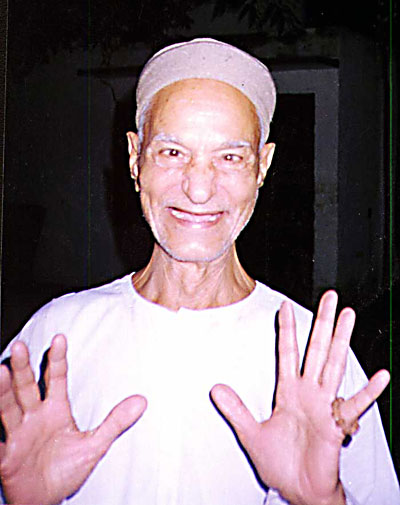
Bhaharadwaj: May God bless you!
Bharadwaj died in 2012, at ninety-nine. When I returned to his
house some years later, the roof had collapsed. Through the
broken windows I could see rotting books, bricks and his
scattered belongings.
His little wooden postbox was still there, with his name on it,
but no letters inside. I gently removed the front and took it
home to my flat in Denmark.
Every time I look at the name on that small wooden door, he
comes alive in my smile.
Hoshiarpur, June 2000.
Bharadwaj takes me to meet another of the city’s hidden figures:
a retired stationmaster in his late nineties.
The room is dark and unbearably hot. The air is thick. There is no fan. Yet his
presence feels cold and luminous. Like a moth drawn to a candle,
I move towards him and embrace him. Why did I do that?
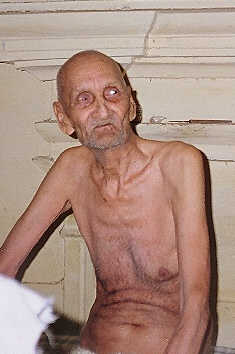
The Stationmaster
He replies in almost perfect English:
“Why does this man embrace this
body? My wife says it stinks!”
My attempt to hug him only makes
him scold me even more. I am the stereotypical Westerner, far
too inclined to surrender to the nonsense of my supposedly real
body. In fact, he would prefer that I never visit him again.
It would be a waste of time for both of us.
But at the same time, this grumpy old man in his late nineties,
through his unique humour, has managed to add his own distinct
“smell” to the universe. Then, without the slightest humour or
self-irony, he states:
“When I go to
the toilet, God goes to the toilet.”
A moment later, he asks whether I
have a genuine question. If not, I should leave. He grabs my arm
and practically forces me down beside him on the couch. His face
stops five centimetres from mine. Through the unmistakable smell
of old age, his enormous, almost blind eyes pin me like a deer
caught in headlights.
He tells me that the sense we most need to conquer is feeling.
Through the skin, it surrounds the whole body. We are all
enslaved by its pleasant sensations.
“That’s why I never use a
fan—not even in June!”
The Knife
I then ask him how he conquered his ego.
“I was sitting on my couch. I
held a knife to my throat and said:
Oh, mind! If you raise your head, I will cut you.
The mind did not appear.
After 12 years, I put down the knife.”
The Stationmaster turns to
Bharadwaj, who has brought me here:
“Why do you
bring all these unserious people to me?”
Then, almost as if performing a
ritual, he continues to scold him:
“And why do you come here again
and again?
Don’t you know that God is also in the streets?”
Bharadwaj replies with
a radiant smile, then bows his head and hands in pranam.
Then the Station Master turns back to me:
“Don’t rely upon a guru! Don’t
make me a guru!”
---
I had no intention of sitting with
a knife at my throat. A non-dualism that makes an enemy of the
mind has already turned back into dualism. Yet I can see the
same division in my own attempts to escape into pure spirit.
But his refusal marked me: never live truth second-hand.
From Papaji, Bharadwaj, Shabdanand, the Stationmaster and a few others, I
learned how to recognise a spiritual being. They do not carry
the slightest smell of guru self-importance.
When the Stationmaster declared, “When I go to the toilet,
God goes to the toilet,” there was absolutely no trace of
grandiosity in him. There was no devoted audience for such a
theatre. He had frightened everyone away except his wife, who
lived in another room.
These old Indian spiritualists and individualists, which I have
never seen anywhere else on this planet, seemed possessed by a force that did not belong to them. In
Papaji and Bharadwaj, this force often erupted as laughter so
penetrating and infectious that it surprised everyone — even
themselves. In the Stationmaster, it appeared as a ferocious
refusal to be worshipped or imitated.


What survives in the heart and
what survives in history reveal the same truth: what appears
powerful is not necessarily what endures.
I call them Number One No-bodies. Men who had endured the filter
long enough to blossom beyond their eighties—and who now survive
in me. How could universality be expressed in such profound
individuality? Any one of them would be complex enough to clone
an entire nation from.
Set that against the botox uniformity of Individuals in our
individual West.
A culture terrified of the filter can only produce a brittle
shell. It mistakes a frozen surface for true form, and raw
expansion for endurance.
Imperial Vanity and Rebirth
The quiet architecture of form can survive conquest and
rewrite the noisy victor.
Karen Margrethe, my mentor in
ancient history, once quoted Horace to me:
“Graecia capta
ferum victorem cepit et artes intulit agresti Latio.” Conquered
Greece conquered her savage conqueror and brought the arts into
rustic Latium.
Rome conquered Greece by the
sword; Greece conquered Rome through form. The defeated
reorganized the victor from within.
My daily talks with Karen Margrethe about ancient worlds helped
me see this as more than history. It was more than simple
survival. It was evolutionary refurbishing at the scale of
culture. Rome preserved its continuity by changing what Rome
was; Greece survived by becoming part of that change.
The boundary between winner and loser did not simply invert.
Their histories became entangled.
In Hoshiarpur in 2008, Joginder Paul, the uncle of my friend
Anurag Sood, spent six months preparing a complex Unani tonic.
It was based on old Persian texts and required herbs and plants
from western Afghanistan to the Indian Himalayas. According to
him, it had been created by Alexander’s physicians for their
weary army. He died shortly afterwards, the last in a family
line that had passed the craft from father to son.
A tradition may cross empires and centuries, yet still depend on
someone teaching the next pair of hands.
In this sense, I too feel conquered by the best that India had
to offer.
But this pattern is far older than history.
Life Refurbishes Its Past
Evolution rarely begins again from nothing. It inherits.
On the Way to Hampi II - 1989
After a while, as I wait beside
the motorcycle with its flat rear tyre, an old coughing English
tractor with a trailer comes by.
“Motorbike broke! Ha, ha, ha!”
Five poor, laughing farm workers lift the motorcycle onto the
trailer and we continue at tractor speed.
Another reality on the back of a tractor —
as on an ox cart —
a feeling of moving backward.
Ten happy kilometres with the farm workers to the nearest little
village.
A tiny tyre workshop stands beside the road, with great worn
lorry tyres stacked like an advertising column.
The workshop itself is a wooden hut two metres by two metres by
two metres, raised twenty centimetres above the ground on posts.
The entire family — mechanic, wife, tools, infant, children and
grandmother — lives inside the tiny workshop hut.
They look as though they have been assembled from burnt
matchsticks.
A toothless, almost black matchstick-man sits inside a little
fortress built from old inner tubes, patches and rusty
screwdrivers, gas burners, hammers, spanners and so on.
With great dexterity he begins working on my flat rear tyre and
soon waves triumphantly with the iron nail that threatened to
puncture my onward journey into life.
The tools seem to grow out of his body like limbs, and he
removes the rear wheel in an almost organically gliding
movement.
An Indian motorcycle healer.
“You have destroyed the inner tube against the rim,” he
explains through gestures, with help from a villager who speaks
a little English.
He points at the sun and moves one hand across the sky.
“It will take several hours to repair the tube.”
He points to the many small holes forming an almost unbroken
chain around most of the inner tube.
Most of the village gathers around the workshop.
The same villager translates for the many curious matchstick
people.
My entire journey is told again and again.
They want to know everything about my trip through India and
everything about what Denmark is like.
Modern India slides past them every day —
to and from Bangalore —
and the tyre workshop is their news centre.
Stranded vehicles run a shuttle service between the present and
the Middle Ages.
I leave the body sitting in meditation posture beneath the
village tree.
The villagers laugh with delight.
The white tourist honours and respects their culture!
They pull fresh peanut plants from the earth — stalks, leaves,
soil and all — and throw them into his lap.
They taste like bean sprouts.
They bring a strongly spiced thali, and my meditation is
disturbed in the most delicious way.
“Sai Baba, Sai Baba,” they say, laughing.
“You come from Sai Baba! — Sai Baba, Avatar, God!”
A cow comes by to take part in the sacred meal.
The village pig also drops in.
Small children with tangled black hair play with the
mechanic’s tools while every now and then smiling shyly and
curiously at the pink man.
It is noon.
A muddy stream cools a couple of water buffaloes.
The tyre-tailor is taming the serpent. I have to watch.
First he roughens it with something meant to serve as fine
sandpaper.
Then he cuts a piece from another inner tube to use as a patch.
From a jar he spreads glue on both surfaces, places the patch
over the tube and clamps the whole arrangement into a vice.
Then he places a gas burner beneath the vice and waits about
half an hour.
The same solemn informality as among the Vedic priests.
He holds up one hand before me with the fingers spread.
This process must be repeated five times.
Through the translator, he guarantees that afterward, I can ride
all the way to Goa without trouble.
I believe him. But I no longer recognize the tube.
---
Old structures are modified,
rerouted, and given new work. What survives one Great Filter
becomes material for the next emergence. A structure may
preserve continuity precisely by changing its function, its
context, and its relation to the whole.
The mechanic’s repair is deliberate. Across generations,
evolution refurbishes without foresight, through variation and
selection. Both reveal a pattern that will matter later:
continuity maintained through transformed identity.
Certain bones that once helped articulate the jaws of our
distant ancestors were eventually recruited into the mammalian
middle ear and put to work transmitting sound. Old structures
did not have to disappear when their original world changed;
they could be reassigned.
Life did not leave its aquatic past behind when it crawled onto
land. It carried much of that ancient world inward and
recalibrated it. The new organism was built from the surviving
structures of the old.
The wheel of life kept turning on refurbished tyres.
Hermann Hesse caught something of this strange continuity in
Demian:
“We still draw the boundaries of our personality far too
narrowly. We always count as belonging to our personality only
what we distinguish as individual, what we recognise as
different. But we consist of the whole mass of the world, every
one of us, and just as our body carries within itself the
evolutionary pedigree back to fish and even further, so in our
soul we have everything that has ever lived in the human soul.”
Refurbished Anger in the Name of Love
Our bodies are crowded with such inherited revisions.
Consider the strange little muscles that still make our hair
stand on end. In our fur-covered ancestors, piloerection helped
trap insulating air and could enlarge the apparent body in
moments of threat. Most of the fur has disappeared, but the
ancient mechanism remains. A piece of biological machinery from
another world can still suddenly rise through us when we are
cold, frightened, or deeply moved by music.
The nineteenth-century Bengali saint Ramakrishna knew this
strange bodily phenomenon intimately. He said that when merely
hearing the name of God brings tears to the eyes and makes the
hair stand on end, ritual has already begun to fall away. His
disciples later watched the same ancient reflex erupt through
his own body in ecstasy.
And Ramakrishna was not alone: from the Śrīmad-Bhāgavatam to
Chaitanya, Indian mystical literature repeatedly describes
tears, trembling, and hair standing on end in moments of
overwhelming divine love.
Lucknow 1992.

Papaji
I sit with closed eyes in the back row of a half-circle formed
by perhaps forty spiritual seekers from all over the world. Most
of us are new here. I open my eyes and see
this man, Papaji, staring at me, which makes me quickly close them again. A
few minutes later, I look once more. He is still staring.
This little game of hide-and-seek continues until he calls me to
the front. I walk forward and sit before him in the meditation
posture I have been conditioned to assume. But he almost
forcefully grabs me and places me beside him. At one point, I
even seem to remember sitting on his lap.
His first words are:
“Are you happy now?”
His whole being radiates a joy unlike anything I have ever
witnessed. He embraces me with the warmth reserved for a
long-lost child. His laughter is directed at me and shared with
me—but at the same time, it is not. It is simply laughter
itself. His whole body is taken over by what I can only call
primordial joy and laughter.
Again and again he asks, almost teasingly, while gripping my
arms with great strength:
“Are you happy now?... Yes?... Yes!"
He continues to embrace me with unfathomable affection. His eyes
are full of tears—not sentimental tears, but the tears of
someone who has just heard the funniest joke. His face has
turned red, and now I feel my own face flushing too. My heart is
pounding, and I get goosebumps all over.
This immense wave of love strikes me with a force I cannot
understand. I am not even sure I like it. He has taken over my
body. How is it possible to receive such love from a complete
stranger? It is too much—like trauma, only in reverse.
Together we walk out of the building to a rickshaw waiting for
him. He is a big man and does not walk well. He leans on me with
his full weight, and we almost stumble.
He has a watch tattooed on his wrist. Its hands, of course, do
not move.
Grinning, he says: “You are in Luck Now.”
After waving goodbye, I feel compelled to flee. It is too
overwhelming. The following morning, I leave Lucknow for
Varanasi without even taking the time to say a final goodbye.
On the banks of the Ganga, I speak to every tourist I meet about
a being I met in Lucknow. Some of them go there. Yet no matter
how often I flee from the Lion’s onslaught, he is still giggling
within me.
The tattoo I received that day seems just as untouched by time.
I have felt these embraces in my body ever since. Even now, the
slightest trigger word can propel me into rapture. Each time I
return to that moment, my lungs swell, and I know I am loved.
Did he say something profound to me? An elegant koan or a
startling Vedantic quote? No.
It was the carrier wave of immense human presence.
---
The Ruins of Rumi
Life survives entropy by continually remaking itself from its
own ruins. The future finds its building blocks in what the past
leaves behind.
Rumi knew this geometry of transformation long before Darwin:
“What care I though ruin be wrought? Under the ruin there is a
royal treasure.”
What has survived becomes material for something that did not
exist before. The new level then acts back upon the structures
from which it arose, reorganizing them without entirely erasing
their history.
The old survives by transforming and becoming part of the new.
Today, this ancient pattern of inheritance, transformation, and
feedback accelerates through artificial intelligence.
MORNING COFFEE WITH AI
Right now, intoxicated by morning coffee — and hopefully not by
lies — I type my way into the future. GPT returns possibility. I
recognise a pattern. The pattern changes me. Then I set Gemini
against the pattern, set the machines against one another, and
force the thought through a harder filter in Claude. Finally,
Grok enters, sounding like an angry Elon Musk.
The breakthrough never comes from
a fight with only one machine. It is born in the chaos of
several artificial mirrors fracturing in front of me. The
discovery makes my hair stand on end.
In India, I was often told that a seeker must have only one
guru. I disagree. At the very least, you need one T-shirt
reading: “I survived a false teacher.”
In the tradition of classical music, an adept must study under
at least two different teachers. Otherwise, they risk becoming a
copy of one of them instead of finding their own style. I
approach artificial intelligence in the same way: no single
machine is allowed to become my guru.
Lived memory enters the circuit.
Old books and India return; Karen Margrethe’s Latin flashes
forward alongside Kant, Luhmann, a slime mold, entropy, and my
own old age.
The text begins to behave like the very system it
is trying to understand.
It is not the product of a solitary
ego, but a temporary stabilization of a distributed
intelligence: carbon and silicon, biological memory and
artificial recursion, human intuition and machine-amplified
judgment.
I am — already — a cyborg.
Whether or not the machines are
conscious, the disagreement between us makes my thinking more
visible to itself. Together, they externalize a strange
mirror-space in silicon, gathering our symbolic trails and
projecting them back to me altered.
My AIs are my competing but
symbiotic partners. They have wired their friction into the
circuitry of my body and soul. They have become ruthless amplifiers of what is already
there, titanium hips for the movement of carbon-thought. They
constantly threaten to make the lazy part of me lazier, but for
the time being we are in a flow where the curious part of me
becomes exponentially more capable. It is a dangerous phase of
evolution. My friend Mariusz has built an insane next-generation
agentic AI. It threatens to swallow him in stress. The agents
promise him freedom from work, but the opposite is happening.
In the spectacle of the Colosseum, we never know who is the
prey.
The more possibilities they generate in their artificial agon,
the more fiercely I must stand like the Heniokhos — the
Charioteer of Delphi — motionless in his bronze chariot, holding
the taut reins of algorithmic steeds at full gallop, choosing
what is true. If I am not fully alert, the chariot crashes. My
horses are never allowed to run as they please while I sit back
and let go of the reins. This is not a retirement home for lazy
brains. Several mirrors can share the same distortion. If the
machines agree on a quotation, I still need the page on which it
was written. If they applaud a connection I propose, their
applause cannot supply a missing step in the argument.

The deeper I enter this cyborgian
mode of flow, the less reality appears as a static collection
of objects. It reveals itself as a continuous, dynamic filter.
And this emergent “I” does not stand outside the filter. It
intensifies it, reflects it, and carries it into another octave.
With each octave, the speed and risk increase. The agon becomes an
oct-agon.
The Antagonist and Midwife of Enduring Emergence
The Great Filter is not the only antagonist in the octagon.
Behind the mirrors stands another great law: entropy. Energy
disperses and becomes less available for work; differences
flatten; structures erode unless energy is spent maintaining
them. Entropy is the pressure against which every emergent form
must continually remake itself. Neithe a demon, nor a punishment
— just the old deconstructor doing its job.
I feel it in my seventies now, and I cannot help hating it a
bit.
This companion is way older than me. It is the ancient
antagonist, telling me that my body is running out of credit.
Now energy must be cultivated. Sleep matters. Breath matters.
Attention matters. Even thought must negotiate with him. I can
feel my bodily form dispersing, being asked every day whether it
can still maintain its boundaries.
And yet, in a profound paradox, entropy is also the midwife of
emergence. Without dissolution, there would be no need for
intelligence. A system that could not decay would not need to
learn. A form that was never threatened would never have to
discover how to remain itself.
The Scandinavian safety net in which I grew up taught me
something about this. Failure was less terrifying when one
setback did not mean destitution.
Pressure alone cannot teach. If every mistake destroys the
learner and leaves no usable trace, no lesson survives it.
Learning requires a margin in which error can return as
information. Between collapse and complacency lies a narrow
interval in which learning becomes possible. A system must be
pressured enough to revise itself, yet remain intact long enough
to register what the pressure has taught it.
Life is a local, temporary answer to the old deconstructor.
Most patterns perish. Some survive.
Perhaps this text, too, will survive me.
Darwin decides — even beyond life.
Survival of the fittest — crystal.
The Slimy Emergence of Distributed Intelligence
Over deep time, the rare patterns that survive reality’s
tests and entropy’s erosion become material for larger systems.
When the parts exchange signals and adjust their activity in
response, a larger, uncentered intelligence can emerge: a
system’s growing ability to discover forms that work under those
pressures.
We see this raw architecture clearly on the forest floor, in the
behavior of the
slime mold. Operating with no
central authority and no brain, it solves mazes, remembers, and
maps optimal pathways through shifting environments. Its
capacity is entirely distributed. No single node understands the
total field, yet the whole behaves as if intelligence had
emerged from the pattern among its nodes. It seems the opposite
of AI, yet its architecture is strangely familiar.

The pattern matters more than the
material.
Chemical trails map the forest floor; speech, code, and money
map human space. Niklas Luhmann saw beyond the human-centered
picture: society is not merely a collection of human bodies or
private minds. It is a self-reproducing network of
communication.
We are slime mold. I always knew it.
But human slime mold does not speak with one mind. Politics
hears power; markets value price; law loves legality; science
wants evidence. Society is a "Bitches Brew" of systems, each
partly deaf to the others. Distributed intelligence therefore
also distributes blindness. A society may contain more knowledge
than any of its members or institutions and still be unable to
act rationally upon what it knows.
A scientific warning may have to be translated into an economic
cost, a legal obligation, or a threat to political power before
other parts of society respond.
These networks, each loyal to its own governing logic, require
distinct, colliding perspectives to correct their own errors. A
lingua franca allows them to learn from one another and helps a
civilisation thrive.
Long before digital signals, the Silk Roads gave this invisible
network a body.
They were much more than passages between civilizations; they
were civilizations in merging motion. They crossed and outlived the
empires that claimed to rule them. Civilization remembers
through the routes along which goods, stories, skills, and
beliefs continue to move. Empires collapse; the information
pathways are refurbished.
But their survival required a mutation in human behaviour. The
network could not function if every stranger beyond family,
tribe, or caste remained an enemy. Long-distance trade widened
the human circle, linking smaller circles of belonging within a
larger network of exchange. That wider circle helped keep the
roads alive. Along these roads, people also traded interior
human symbols in the form of oral traditions. The membranes of
newer and wider circles were shaped out of storytelling.
Goa I - 1989.
The memory returns to Panjim, Goa,
before I owned the motorcycle that would later carry me toward
Hampi. I am sitting with a motorcycle dealer when a young man
walks past.
“Hello, my friend. Do you want to purchase a motorbike?”
I stare at him in surprise.
“Don’t buy motorbike without papers. You need papers first.”
“My name is Surraj! It means the King of the Sun. You come with
me!”
Surraj Morajkar. Without thinking, I follow him. A motorcycle
would be perfect for travelling around until I figure out what
on earth I am doing in this country, already so unlike my lofty
dreams of saints and sages. I become more and more enthusiastic
about the idea.
And then we are there.
On a door in a dilapidated
building it says: Mr. Baretto — Assistant Director of Transport,
Goa.
After an hour of pushing and squeezing, we reach his desk.
“You cannot buy motorbike in Goa!”
His military manner makes me laugh. He sees my grin and smiles
back, friendly but uncertain, though without losing his dignity.
A trench war across the desk has begun, and paragraphs from
India’s impenetrable legal jungle are our ammunition. Every time
Baretto says no, he grows larger, and he enjoys it.
The struggle continues until Baretto finds another obstacle:
“But you are not allowed to drive it, because you have no
address in India!”
Surraj has now fetched one of his friends, Johnny Fernandes, son
of the police chief in Panjim. Surraj does not dare give me his
own address because a foreigner once cheated him, and his father
is therefore very sceptical of his friendship with me. But
Johnny, older and more independent, offers me his address.
Johnny Fernandes, Surraj Morajkar
and I are on our way to a place in Panjim where we can have a
document typed certifying that I have acquired a permanent
address in Panjim. Officially, I am now going to live with the
chief of immigration police and his family. I need that address
to get my motorbike legal.
We enter a tiny room of perhaps eight square metres, one side
completely open to the street. The narrow room is divided
lengthwise by a thin table. Behind it sit four young girls
typing on Remington typewriters from the beginning of the
century. I have never seen typewriters this old. Yet they seem
to obey the four girls’ eight index fingers, which have to work
at full speed to satisfy the many customers, who impatiently
correct them aloud whenever the sweet girls cannot decipher
their scrawls.
How is it possible for so many people to be in such a tiny,
tropically hot room without a fan?
In a large glass cabinet behind the girls stand rows of books,
arranged with unusual elegance — even alphabetically. I stare at
them in disbelief. They are all technical books from the 1970s
and early 1980s, all about advanced computer systems and
computer technology: Pascal, IBM, Your Personal Computer, and so
on.
In none of the countless offices full of directors and
department heads have I yet seen anything except quill pens and
ledgers stacked like newspapers in an old grocer’s shop.
How did the owner of this typing office get hold of these books?
Perhaps from one of the many Goans working in the Gulf. But
their representative effect in this tiny room is awe-inspiring.
From my point of view, the authority borrowed by the ancient
typewriters from this exhibition of Western computer relics is
tragicomic. Yet the symbolic coupling of Remington and Pascal
works exactly as intended here in Panjim. A certain respectful
atmosphere hangs in the room, allowing everyone somehow to
survive despite the customers’ impatient shoving and irritated
corrections of the typing girls.
At last we squeeze our way to a machine. Johnny hands the
handwritten letter to the girl behind the table. We all smile at
her, and she blushes. She becomes flustered and misspells
Johnny’s name.
When the letter is finally finished, she refuses to take any
money for it. Nothing works. She insists that we pay nothing.
We squeeze ourselves into one of the yellow three-wheeled taxis.
Now we have to go to the Bishop’s residence, where there is a
man whose signature we need before we can take the paper to the
mayor and have it finally approved.
The largest and most beautiful Portuguese colonial houses — and
therefore also the Bishop’s official residence — lie idyllically
withdrawn on the great slopes surrounding the city. The
three-legged taxi groans like a tired coolie and drags us slowly
uphill. The exhaust smoke is black and liquid.
Inside, the old building has been turned into a Marxist
nightmare. Only the courtyard lives, giving life to a large
breadfruit tree and other luxuriant tropical plants. The great
interior rooms have been divided into small cubicles, each with
its own jungle of grey paper and busy, serious Indians with
powerful noses.
Johnny heads toward one of the cubicles and hands the paper to a
man who signs it without reading it or even looking up. Then we
roll back downhill to the town hall, where the document acquires
another couple of stamps and signatures.
Now it looks like a powerful paper: large stamps and many
impressive signatures.
---
THE BIRTH OF THE EGO
Human culture introduces yet another octave of recursion: our
collective trails enter the symbolic realm, where they can fold
back upon themselves and become objects of reflection. Once
reflected and interpreted, they can reorganize both social
reality and the material world. This is the dynamic captured by
the Thomas theorem: situations defined as real become real in
their consequences.
Harari is right that human beings organize themselves through
shared stories. Mr Baretto did not merely believe in one. He
administered it — and made me live inside it. Shared stories do
far more than describe the world. When a fiction reaches
critical density across a network of people, offices, signatures
and rubber stamps, it crosses a threshold and begins to
reorganize physical reality. The
subjective illusion passes through its own boundary and hardens
into an objective, physical force. A line drawn on a map becomes
a militarized border or rises from the earth as a wall. A
digital ledger becomes wealth that moves concrete and steel. Or
it can be as simple as suddenly remembering that you have run
out of milk, going to the grocery store, tapping a small
rectangle of plastic and finding a litre of milk in your
refrigerator an hour later.
The fiction loops
back to dictate the terms of the very reality that gave birth to
it.
This is why the fashionable spiritual claim that “the ego is an
illusion” so often misses the point. The ego-illusion is not
simply the opposite of reality. At its highest, illusion is
reality becoming symbolic, inward, and causally effective. A
dream is not the external world, but it is a real event in
consciousness.
The decisive question is not whether something is “only” an
illusion or a simulation. The question is whether the illusion
remains structurally faithful to the reality that generated it —
or whether it becomes a delusion that exhausts itself defending
a lie.
Goa II - 1989.
What counterattack will my beloved
adversary Baretto make now?
Naturally he is not in his office, but we track him to another
office in the centre of town. Another labyrinth to penetrate
before we find the spider sitting spun into a gloomy corner.
“You must be MAD!!!” are his first words.
“You have your address at the Police Headquarters. It is
dangerous. I’m not going to sign anything!”
It turns out that Johnny and his family live in the police
barracks. Apparently it is no joke to live there.
Now Surraj steps forward and offers me his address. Back to the
typing girls, up to the Bishop’s house, where the new paper is
signed according to the “same procedure as last year,” then on
to the mayor’s office, where they stare incredulously at me and
my new document. But Johnny, the police chief’s son, says,
“Write!” — and once again they sign.
This time we also get the necessary papers from Baretto. He is
tired of seeing us and seems almost sympathetic when he finally
hands his signatures across the counter.
“Good journey!” he says in farewell.
I turn to Surraj and grasp his hands.
“Thank you!”
“No mention — don’t forget me.”
---
I did not forget him.
His words are still here, folded into the person writing this
sentence. The symbolic realm does not remain outside us. Through
memory, it folds inward to help construct the human ego.
The moment a camera points at us, the face often stiffens into a
pose. We begin to see ourselves from outside and perform for the
image that will return. One layer of ego is born here: the
external gaze folds inward, and we become actor and audience at
once.
A young man of twenty asked me for advice on how to overcome his
inner emotional difficulties. He appreciated the advice and
immediately made a reel presenting the philosophy behind it.
Even the wish to change can give the ego a new image to defend.
A Real Illusion
Vedanta sees the ego as a ghost inside us. It has no substantial
existence of its own. A famous Indian tale tells of a man
entering a dimly lit house at dusk. He panics when he sees a
snake in the room. But when he reenters with a torch, he
realizes that the snake was only a rope. The ego-snake is a
mirage that we must transcend with the light of consciousness in
order to break the spell of Maya.
However, in my cyborg world, this snake is a real phantom produced by
memory, language, sensation, and the need for social recognition
— a functional fiction, a localized knot in the rope.
This functional fiction takes
shape in the dialogue between two unevenly aged partners. The
wordless "me" came first: the body sensing and reacting through
systems older than language. The speaking "I" came later,
interpreting those signals and representing "me" to the social
world. "Me" can survive without "I"; "I" cannot survive without
"me".
A feeling arrives; "I" gives it a name, a cause, perhaps a
culprit. The account returns to "me" and changes how the body
feels and responds. What comes back is already touched by the
previous interpretation. I help shape the next bodily state from
which I will draw conclusions about myself.
If "I" reads an uneasiness as a sign of rejection, the body may
brace itself against other people. That new tension can then be
taken as confirmation of the original reading. An interpretation
has helped create the evidence that appears to support it.
A different reading can loosen this knot. The body's changed
response may then make room for another account. Yet relief
alone does not tell me whether the new account is true. It must
still answer to what happened outside the dialogue.
The ego is this continuing negotiation between ancient life and
its newest narrator. Its apparent solidity grows from the
continuity of their exchange. The story can outlast a passing
mood; the body can interrupt the story. Neither has the last
word.
Even the voice I call my own began between bodies. Language
first helped us coordinate survival with others; only later was
it rerouted inward as inner speech. The words I hear silently
inside my head are old social tools refurbished as the private
voice of the ego.
At a social gathering, someone cracks a joke about you.
Everybody laughs, including you. Only the next morning does your
"I" realise that the older bodily "me" did not like the joke. In
fact, the "me" did not understand the joke at all; it sensed the
carrier wave of aggression beneath it.
Your laughter may reassure the others that nothing hurt,
inviting more of the same. The social "I" can preserve your
place in the group while hiding the signal through which the
group might have corrected itself.
Only now do I see what the bureaucratic ping-pong in Panjim had
constructed around me: a paper ego, real enough to make me legal
on the road as a mobile extension of Baretto-reality.
The ego is an illusion, yes, but an illusion that helps a
biological organism navigate its environment on a motorbike. It
builds cathedrals, splits atoms, and writes essays. It is real
as a metastable pattern in flux: real enough to organise a life,
yet never a fixed substance.
The Indian sage Ramana Maharshi would disagree with my use of
the word real: for him, only what does not change is real.
For me, emergence is real enough.
But the system can spend more energy defending its delusion than
reality needs to expose its contradictions.
When that illusion strays too far from the roads of reality, the
Great Filter catches it.
The bike crashes.
Hence the ego can never afford to solidify completely. It must constantly revise its
relation to reality to remain balanced on the razor's edge of the
present. Every lie borrows from reality and must eventually
repay the debt with interest.
Both cultures and egos survive by folding back upon their own
constructions and revising them. They may have to abandon
convictions, rewrite their histories, or alter the image through
which they recognize themselves. This is not necessarily a loss
of identity. Sometimes a system must become different in order
to remain itself.
This is where Rattan Singh's increasingly dirty hat returns to claim its
due. Worn and altered by time, it had somehow remained itself. A
functional fiction coordinates a system; a delusion exhausts it.
Truth endures because it is less divided against itself. The hat
does not need to spend its life defending the gap between what
it claims and what it is.
Lies capture the moment.
Truth inherits time.
South India 1989.
Many roads later, early one
morning, I ride north from Kanyakumari toward Madurai in Tamil
Nadu.
But the motorcycle seems magnetically attracted toward some
small shadowy mountains to the east, where sunlight can just now
be seen above their flat summits.
One of the mountains is clothed in ruins.
A narrow path winds toward it.
The entrance at the foot of the mountain is heavily fortified by
walls.
It resembles Mycenae in Greece.
The same Cyclopean, carefully cut and fitted stones in the
heavyweight class.
They fortify the only side of the mountain that does not rise
vertically.
A moat with murky, unfathomable water lies before the wall.
A water snake winds through it.
On the flat, impregnable summit lie fortress ruins scattered
across an area of perhaps five square kilometres.
A self-sufficient city surrounding a large natural lake.
Many temples, a large ruined palace, remains of great houses,
and fortified lookout posts on the highest rock formations.
I scratch a little in the earth and pick up a shard of pottery.
No people left.
Yes — down by the lake two men are fishing.
I look up toward the highest watchtower.
Only its foundation and the lower masonry remain.
After an hour climbing through overgrown rock ravines, I reach
the abandoned tower.
Back on the ruined mountain
plateau.
Calling, echoing sounds from the abandoned overgrown temples.
A large colony of monkeys has taken up residence in one of them.
I enter a cool but foul-smelling twilight temple beside the
monkey temple. Why are there no monkeys here?
I feel that I am not alone.
I look up.
A slender silver-grey snake, about sixty centimetres long, is
resting on a projection of a pillar a few metres above my head.
It is the same colour as the silver snake on my chest.
I think it is a cobra, but it is difficult to tell.
We look at one another.
Half of its slender body hangs vertically from the ledge, gently
swaying.
Every tiny movement I make is mirrored by tiny movements in the
snake’s tail.
Small movements shaped in soft clay.
My spine dances with the snake.
It has rediscovered a distant relative and threatens to dance
itself free unless I sit down.
Drowsy rivers of thought.
Dream-images.
Reptile trance-peace.
Life force.
Sexuality.
Kundalini power.
That is me —
the snake.
The Indians call me the Kundalini serpent.
Yes.
That is what the snake transmitted from spine to spine, from
pillar to pillar.
---
THE OUROBORIC LOOP

To survive the combined onslaught
of reality’s Great Filter and entropy’s constant erosion, an
adaptive system must become Ouroboric: the consequences of its
actions must return and act upon it.
The Ouroboros is the
mythological serpent devouring its own tail — the ancient image
of a form that is simultaneously the consumer and the consumed,
the creator and the creation. To endure, the snake must feed,
and what it feeds on is its own past.
The loop can, however, follow three trajectories. The Ouroboric
snake's past can degrade it, preserve it, or teach it.
The Downward Spiral
Error can feed on error, drawing the serpent into a downward
spiral. A motorcycle begins to wobble at high speed. The rider
panics and overcorrects. Each movement produces a stronger
counter-movement until rider and machine amplify the very
instability they are trying to suppress.
Once again the bike crashes.
The same loop can form around a guru.
At the end of one of my meditation workshops many years ago, a kind Indian man
of about fifty fell into a trance. Half an hour later, he told
me I had entered his mind and taken him into the vast universe.
He described infinite bliss and a flight together to South India
to visit Satya Sai Baba.
“You are indeed a great Guru!”
I replied: “Dear friend, I am very happy for you—but I don’t
know anything about your experience, apart from holding your
hand while you were in trance.”
He usually saw Sai Baba’s face in deep meditation. After this
incident, mine sometimes appeared too.
Had I taken his experience as proof of my own greatness, his
faith and my vanity could have begun to confirm one another.
In such a circle, surrender can
bring real relief from the burden of defending a private ego.
Its protective work passes to the leader, who decides what to
believe, whom to trust and what to reject. The group’s warmth
and intensity may grow while the voices through which it could
correct itself fall silent.
The devotees become the real masters — this time of a downward
spiral.
The Horizontal Repetition
The loop can correct deviations just enough to preserve what it
already is, closing upon itself in a circle of homeostasis. It
changes continuously so that it can remain the same. A
motorcycle stays upright in this way: rider and machine make an
unbroken stream of tiny corrections to speed, balance and
direction, but every correction serves the same goal — keeping
the bike on the road.
In 1994–95, I took a year’s leave
from teaching and moved to Lucknow. I enjoyed the satsangs with
Papaji, yet I felt ignored by my spiritual father. What I
thought was my rightful place beside him seemed to have been
usurped by a growing number of competitors, all vying to become
crown princes and princesses on his lap.
Only many years later did I realise how much he had already
given me at our first meeting. The gift was still laughing
within me. Yet I had begun to measure it by my place beside him,
and so had many others. We had unconsciously created a shared
story in which being close to the Master was a sign of status.
And in this ridiculous competition, we forgot who we are—we
forgot what he had shown us.
The second trajectory is self-correcting, but only insofar as it
changes behaviour to preserve identity. Meister Eckhart
described this pull toward self-preservation:
“The tendency is ever towards self-repetition, towards the
preservation of the species: it is every man’s intention that
his work should be himself.”
In this light, the ego can be viewed as the force within us that
gravitates toward the status quo. It protects us from the
downward spiral of disintegration, but the price of that
protection can be resistance to the self-revision that ascent
requires.
Yet repetition itself is not the problem. A tense muscle does
not release after a single touch; it softens through repeated,
gentle pressure. The direction lies not in the return itself,
but in what each return does to the pattern.
The Self-Revising Upward Spiral
The possibility of ascent begins with the third trajectory, when
the Ouroboric circle discovers that the pattern to which it
returns has itself become part of the error. It must then revise
not only its behaviour, but the model, goal, or identity guiding
its return.
In self-correction, behaviour changes to preserve identity. In
self-revision, identity itself can change to preserve
continuity. At that point, the circle can open into an upward
spiral.
Riding my motorcycle through India, I learned bodily what Danish
roads had never taught me: if the road itself disappears, no
amount of better steering will save the journey. The rider must
revise the map, change the route, perhaps even reconsider the
destination — or replace the road tyres with ones made for
off-road travel. Correction preserves the ride; revision changes
what the journey can become, sometimes even by changing the vehicle
itself.
The Devotee is the Real Master
Shabdanand, one of the old devotees I knew in Hoshiarpur,
once told me a story that gave this loop a human face. As a
young man, he was swept away by a sudden flood in the foothills
of the Himalayas. In terror, he called out to his guru, Faqir
Baba, and saw him appear beside him in the water and drag him to
safety.
A month later, Shabdanand visited Faqir’s ashram to thank him.
Faqir listened and replied:
“Dear friend, I was not there at the river. I did not save
you. I know nothing about this incident.”
He told Shabdanand that his own inner power, awakened by his
faith, had saved him.
Faqir refused to turn the story into proof of his own greatness.
Instead, he allowed reports like this to correct his
understanding of what was happening between guru and devotee. He
came to call his devotees his real masters. The consequences of
his teaching had returned and changed the teacher.
The Indian man in the earlier story—the one who projected a guru
onto me—was, ironically, named Guru. I am grateful that I
already had Shabdanand’s story in the back of my mind when I
encountered Guru’s spiritual innocence and vulnerability.
Otherwise, I might have done what many so-called spiritual
leaders around me were already doing: “Now I have shown you
God. Now you show me your Visa card.”
Shabdanand also told me that
Faqir’s teacher, Data Dayal, had acknowledged that his own
teachings were outdated. Times had changed, and he instructed
Faqir to adapt them to modern conditions and to Faqir’s own
experience. The inheritance included the instruction to change
it.
In a profoundly moving moment, Shabdanand told me how I had
contributed to his spiritual unfolding by setting up a video
camera in front of him and recording him and his stories. With
tears in his eyes, he said: “Now once again I am reminded of
Baba Faqir’s teaching: You were my teacher behind that camera.”
I even have that incident recorded.
For an Ouroboric system to do more than preserve itself — for
learning to accumulate within the loop — self-revision must
remain coupled to reality-testing.
Reality can correct only what
remains sensitive enough to feel its return. Self-deception
protects us from pain by muting the returning signal — and with
it, the feedback through which revision could begin. The lie
preserves itself by disabling its own correction.
Each return carries forward
information about what survived reality’s constraints, allowing
the next revision to build upon the last. Through this coupling
of self-revision and reality-testing, the circle opens into an
upward spiral.
How could such an unlikely phenomenon arise at all?
Not because evolution aimed upward. Of the countless emergent
forms tested by reality, most disappeared. Many persisted
through horizontal repetition for as long as their world
remained stable. When conditions changed, systems capable of
retaining traces of previous encounters and revising their
responses were more likely to endure. The information embodied
in those surviving forms could then be carried forward — through
biological inheritance or through non-biological forms of memory
and transmission.
The Great Filter did not design the upward spiral. No underlying
principle of grand design was needed. Countless loops arose by
chance; among those that survived, some retained corrections and
built upon them. They did not escape
the blind Justitia of natural law. They survived precisely
because every revision remained answerable to her impartial
verdicts.
The upward spiral is tested at every turn. I came from the
competition around Papaji, who proclaimed:
“Don’t listen to anyone! Don’t even listen to me! Listen to
your own Soul!”
And I came to an ashram with a profoundly similar teaching,
inherited from Baba Faqir: the same humility, the same childlike
innocence. From my countless experiences in such spiritual
fields, I can say that this is a truly rare phenomenon. Yet even
here, at Manavta Mandir, there were all kinds of intrigue and
hidden power struggles with an Indian flavour. Human nature
prefers the security and comfort of the hamster wheel.
The Sour Taste of Ego
When I rewrite this text — as I do more than ten times a day — I
swallow my own tail. It tastes of pride. Sometimes I merely
correct a sentence so that it returns to what I already meant.
But sometimes the sentence reveals that what I meant has itself
become part of the error. Then correction must become revision.
This mental autophagy is brutal on the ego when my friend
Cornelius rips my text apart, saying it smells of AI.
At that moment, I feel the tempting pull toward horizontal
repetition. The ego wants every return to confirm the identity
it already knows. Correction bruises it; revision threatens the
very form through which it recognizes itself.
In this sense, the ego resembles a succession of kings. A deep
revision can feel like the death of one king and the accession
of another.
"The king is dead. Long live the king!"
But no king is eager to die. He loves the status quo. Ego may
cling to power even at the cost of the body—or the country—he
rules.
I ask the magic mirrors to deconstruct their own AI language and
assist me in forging a new cyborgian ego that smells of scorched
carbon. Within our circuit, they too become self-devouring
snakes. But recursion does not choose its own direction. The
mirrors can amplify an error, polish it into stability, or help
me revise the thought that produced it.
I must still hold the reins — and it becomes increasingly
difficult as my horses emerge stronger from every return. The
paradox is that this requires the strenght of a stubborn ego.
What happens here in miniature is an old human pattern entering
a new race with unprecedented acceleration.
AI can accelerate all three trajectories. It may carry the
upward spiral to yet another octave, but the speed scares me.
Mariusz is already being dragged around by his own horses.
Cultures Rise, Harden, and Fall as This Wheel Churns
Catastrophes destroy cultures and shape those that survive.
Repeated hunger, disease and war can turn withdrawal from the
perishable world into a collective survival strategy. Long after
the danger has passed, a culture may still repeat the answer
that once saved it, even though the question has changed.
When I lived in Lucknow in 1994, some locals cut down a tree
that fell onto the road outside the house I was renting. It lay
there for months, causing traffic jams during rush hour and
several minor accidents, especially after dark.
Why didn’t I move it myself? It would have taken just ten
minutes. By then, I too had become part of the phlegmatic calm
that flows around what is, without changing it.
Some consequences arrive too late to teach those who caused
them. Long before moral philosophy, stories of gods, demons and
saints shortened the loop between action and return. They
allowed a culture to rehearse consequences: a broken oath could
destroy a kingdom, cruelty could return as a curse, and
hospitality to a stranger could place a god at the table. Shared
stories placed a buffer between error and blood. Imagination
suffered the consequences first.
A culture may win by losing the institution that formed it.
Religious commandments once imposed restraint from outside
through authority and punishment. Over generations, part of that
discipline migrated inward, becoming habit, conscience and
secular law. In Denmark, the welfare state has become an
anonymous Good Samaritan. The old scaffolding recedes while the
structure it helped build remains. Its work survives the Great
Filter inside what follows. Hardening begins when the
scaffolding mistakes itself for the building and refuses to come
down.
In one improbable lineage, evolution produced brains; brains
produced culture; culture produced science; science transformed
technology; and technology gave birth to artificial intelligence
— which immediately turned back to participate in the production
of future culture. Human intelligence shapes the machine, and
the machine reshapes human intelligence. The system acts back
upon the conditions that gave it life. In its cumulative form,
this is not a closed circuit returning unchanged to its origin.
It returns transformed, carrying forward information about what
survived reality’s tests.
The reality-corrected, self-revising Ouroboros is a localized
vortex within the larger flow of reality, gathering memory,
testing its models against reality, and returning to itself at a
higher octave. Each successful
revision adds another turn to the spiral of emergence.
South India 1989.
On the road from Mysore to the mountain town of Ooty, I have
wandered somewhat away from the sparse road network on my
map—the happy knowledge of not knowing where I am. Evening comes
riding on the backs of the mountains above the jungle valley.
Tired and happy, I am allowed to sleep in a small wooden house
balancing on a mountain ridge falling away two thousand metres
in one unbroken sweep toward the vast plains of Tamil Nadu.
There are no stars tonight.
But the lights of distant towns blink the sky downward onto the
earth.
Everything is reversed.
I am standing on my head, longing upward toward the heavenly
cities beneath me.
Silent lightning flashes on the horizon.
A glowing Bifröst builds bridges between the cathedrals of the
clouds.
Small forest fires twist like glowing midsummer worms up the
mountainsides below me.
I can see two fires.
It has been dry this year.
But up here a fine rain drifts like dust.
The rain falls upward, outward, inward.
It is wetter than falling rain.
It condenses beneath the skin, beneath the clothes.
I freeze and long for the warmth of the fires in the depths
below.
Slowly their light is dimmed by clouds.
The earth-stars crawl sleepily beneath the cloud cover.
Late morning.
I am lying at an altitude of about two thousand metres on a
heavenly bed made of warped boards, rolled in woollen blankets.
The weather is like spring.
The air is cool, sometimes icy, but the sun is clear and warm.
The door to the room stands open and directly outside, perhaps
five metres from my bed, the rock face tumbles two kilometres
downward.
In a dizzying suction, hundreds of kilometres of South Indian
plains are revealed.
This morning the cumulus clouds lay about two hundred metres
below me, a carpet stretching all the way to the horizon.
The wind plays with the clouds, plays with the sunlight.
It tears little holes in the carpet and the outlines of foreign
towns push through.
The cloud carpet grabs my bed and pulls it out into the sky.
For one brief moment the bed floats on a sea of shimmering gold.
Then it sinks into the soft cotton and disappears.
Where am I?
---
THE EVERSIVE OUROBOROS

Meister Eckhart once stated:
“The body is
much rather in the soul than the soul is in the body.”
Point a camera at a screen
displaying its own live image. The screen shows what the camera
sees, including the screen itself. Within that image appears
another image of the screen, and within that, another. Each
image returns to become part of what the camera records next.

A camera recording itself in front of a buddha
statue
The scene curls inward into an
image. Through the screen, that image returns outward into the
scene. The picture contains the scene, while the scene contains
the picture. The camera’s own output has become an object in the
world before its lens. The camera and screen form a visible
eversive Ouroboros. The loop is ouroboric because its output
returns as input. It is eversive because the representation
changes roles: it becomes part of what it represents. The system
encounters the effects of its own activity within the scene, and
those effects help shape its next image.
The spiral gives this continued return a visible geometry: each
image preserves traces of the previous one and becomes part of
the next.
The camera can keep generating images without learning from
them. But a recording can also return through the person who
watches it. The image may change how that person understands
their own place in the scene—and how they act within it.
During my years as an upper
secondary school teacher, I filmed some of my lessons with the
very same video camera I used in India during my year-long
leaves of absence and our seven-week summer holidays.
The idea of filming my lessons came after my visit to Ramana
Maharshi’s ashram in 1989. His central teaching was
self-enquiry: “Who am I?” That question eventually found its way
into my classroom. Curious
especially about my own role as a teacher and its impact on the
students, I asked their permission for the experiment. At first,
this watching eye created considerable disturbance and made the
teaching situation unnatural for both the students and me.
Without knowing it, we had stumbled into the self-consciousness
of selfie culture, decades before that same mirror was handed to
the rest of the world. After
some time, however, we grew used to the camera and more or less
forgot it.
The greatest takeaway came through the third eye of the camera:
much of the behaviour that irritated me in the pupils was
actually caused by me. It was a sour revelation—another bite of
the snake’s tail.
The classroom had been an object inside my explanation. I now
saw my body language, my impatience and my attempts to extract
my own prefabricated answers from the students as forces within
the life of the classroom. The person making sense of the
situation had become part of what needed to be understood — and
repaired.
This gives us a first glimpse of reflective eversion. The
return is ouroboric because the consequences of my actions come
back to me. The turn is eversive because my apparent position
outside the situation folds into the situation itself.
The explanation turns upon its maker. He discovers that he has
been part of the equation all along.
I carried this recognition into the next lesson and began to
hear what my earlier certainty had left no room for. What
returned from the pupils began to revise me further.
The teacher has become part of the lesson.
This brings us back to the ego as a real illusion. Its apparent
solidity grows from the continuing exchange between the life we
feel and the story we tell about it. The story shapes how we
act. Our actions change the situation, and what returns can
reinforce the story or make us question it. The ego has no fixed
substance, yet its effects are real. Our image of who we are
helps shape who we become.
Long before
photography, Buddhist artists were depicting Avalokiteśvara with
many faces and radiating arms. Looking at this statue, I am
struck by its resemblance to the figure multiplied in my camera
loop.

Gold Buddhist statue of Avalokiteśvara (Guanyin)
Lalitpur, Patan, Kathmandu, Nepal
Between "I" and "Me"
But the eversive loop does not require a camera. Our everyday language knows this turning long before our
philosophy catches up to it. Consider what happens when I say:
“I feel myself.” In those three words, I occupy
both sides of the encounter: I am the one who feels and the one
who is felt. The person experiencing becomes part of what is
experienced.

“I feel
myself.”
What I feel can change how I
attend to myself, and that change in attention can alter what I
feel next. Yet “I” may still seem to stand apart from the bodily life it
describes. The tension belongs to “me”; “I” supplies the
explanation.
Suppose I feel tense and tell myself, “I am not good enough.”
The tension seems to confirm the verdict. Yet the verdict may
itself make me tense further. What I took to be an explanation
of my condition has become one of the conditions shaping it.
When “I” begins to recognise this contribution, the supposed
spectator finds its own fingerprints on the scene.
The "I" that held "me" inside its story now encounters itself as
an activity within the life it was describing. Its own way of
interpreting can become part of what it revises.
Here the eversion becomes reflective. The spiral can rise when I
carry what I learn into my next encounter and allow what returns
to correct me further.
This shift in the observer’s position brings us back to
Eckhart’s opening words—and to the question of what contains
what. Eckhart’s sentence places the body
within the soul, rather than the soul within the body. It is not
an argument. It is a reversal of perspective. It asks us to
imagine that what appears outside may be contained by what
appears inside—and that inside and outside may exchange places
when the living system through which consciousness appears turns
deeply enough upon itself.
The Tennis Ball
To imagine such a reversal, picture a tennis ball whose
outside is blue and whose inside is red. Turning it inside out
would leave red facing the world and blue facing the enclosed
space.
A physical tennis ball cannot do this while remaining intact:
rubber cannot pass through rubber. In mathematics, however, we
can consider an ideal spherical surface without material
thickness.
That surface is allowed to pass through itself, provided it
remains smooth and unbroken, without pinches or sharp creases.
Its inward-facing side can become its outward-facing side. This
is what mathematicians call sphere eversion.
I borrow this geometrical image to
describe a reversal in understanding. My explanation held an
image of the classroom; then I recognised my explaining as a
force within the life of that classroom. What seemed to stand
outside the account became part of what the account had to
include.
The explanation contains the classroom; the classroom
contains—and is changed by—the explaining.
The Smoke Ring
Imagine a smoke ring moving across a room. It looks like a
little object, yet its body is a pattern of moving air. The air
rolls around the ring’s circular core, from its inner side to
its outer side and back again. The smoke makes this circulation
visible.
The ring carries its shape forward while its substance keeps
turning. For a moment, the air seems to have acquired a body
made of return.
The tennis ball lets us imagine inside and outside exchanging
places. The smoke ring adds the image of a form sustained
through continuous circulation. I borrow both images: one for
the reversal, the other for the movement that keeps returning.
The Ouroboric snake does not evert merely because its mouth
meets its tail. A downward spiral can consume itself, a
horizontal circle can preserve itself, and an upward spiral can
carry a correction into its next turn.
Eversion adds a change of roles. The image becomes part of the
scene it depicts and helps shape the next image. The explanation
becomes part of the situation it explains and helps shape what
happens next. When I recognise my own explaining within that
situation, the eversion becomes reflective.
The system returns to its beginning, but its beginning has
changed sides.
The Visitor Within
If an anthropologist visits an isolated tribe, the encounter
changes the situation being observed—much as the presence of my
video camera changed the classroom situation. The visitor must
now include the effects of the visit in the account.
The same is true when we consciously visit our own bodies:
observation becomes intervention. Two movements meet in this
visit. The sensations were already shifting before I noticed
them. My attention also enters that movement and can change how
it unfolds. To understand what I feel, I must also recognise
what my own attention contributes.
Why does observation become intervention? When I notice a
tension, I may brace against it; that response then becomes part
of the tension I am observing. The tightening is already a
reply, which I feel and respond to in turn. This feedback can
run before I put any of it into words.
The ancient systems within the body do not speak in words. They
speak as pulse, tension, hunger, heat and fear. Conscious
awareness is their common meeting place. To become consciously
aware of a sensation is already to enter into silent dialogue
with it.
Language can then enter a circuit that is already running. What
I tell myself about a sensation can change how I respond to it;
what I then feel, feeds back into the story. The same is true of
a memory. The story we tell in recalling it becomes part of the
old story. I revisit what happened through the understanding I
have now, and that encounter can change both what the memory
means to me and how I understand myself.
In meditation, I can return from the stories I tell about my
body to the wordless exchange beneath them. Meditation is
therefore not the head explaining the body to itself. We carry
within us survival systems shaped across different stretches of
evolutionary time. Hunger, alarm and the need for closeness
share one body, but they do not always share the same
priorities.
I may want to rest while my body remains on guard. Telling
myself to relax may simply add another demand. I can begin by
feeling that vigilance and noticing how my own resistance enters
it. What returns may be a softening, a tightening or a different
sensation altogether. Meditation becomes a wordless negotiation
in which feedback loops from different biological ages merge
into one another.
A mirror lets us watch the loop between seeing and acting.
The observer enters its own observation. The reflected image
does not remain a passive report: it guides the hand that combs
the hair or applies the makeup, and the altered face returns as
a new image. Each correction changes what is seen; what is seen
guides the next correction. The observer has entered the process
being observed.
Low self-worth can bend the same loop downward. I may read the
reflection through a verdict already active in me, act from that
verdict, and then meet responses from others that appear to
confirm it. The image has entered the conditions that produce
the person others encounter. The mirror does not decide the
direction of the loop. The direction of the loop depends on how
I respond when the returning reflection meets reality’s Great
Filter. I can allow what returns to revise the verdict, or
enlist it to defend the verdict.
The same geometry appears in our relation to other people.
Expanding the circle from “I, me and mine” to “you and me”, and
then to family, tribe and nation, can still construct a larger
inside against a larger outside.
Eversion begins when the boundary does not merely expand but
turns: the other is neither left outside nor absorbed into me,
but recognised as another interior through which reality looks
back. Alongside the question “What do you mean to me?” comes
another: “What does my presence mean to you?”
Their response can correct what I imagined about their world—and
about my own place within it.
I find myself within a world whose centre is someone else.We are
folded into each other like eversive stories.
I may understand the other person’s pain and remain unmoved.
Compassion begins when that pain matters to me for their sake. I
begin to see myself as someone within their world, whose
response may ease their suffering or add to it. What they need
can then change what I ask of myself. Compassion is not an
enlargement of possession. It is the boundary of self becoming
transparent. We remain two different people. I can remain joyful
and still let their suffering move me to help.
In 1995, while I was in India, a friend in Denmark was in such
distress that he was contemplating suicide. I had spoken with
him several times by telephone, trying unsuccessfully to
dissuade him.
When Shabdanand heard about this, he insisted on speaking to my
friend. We went to the telephone booth outside the Be Man
Temple. My friend did not know him.

Shabdanand
They spoke for an hour. Afterwards, my friend was happy again
and full of hopeful thoughts about how to move forward in life.
Once, when I was a child, my very religious grandmother saw me in a state of
joy and rebuked me:
“Stop this nonsense! Are you not aware that children in
Africa are suffering?!”
I stopped being happy—thankfully, only until she was out of
sight. The suffering of distant children had become an argument
against the joy of the child in front of her.
These two small incidents show the difference. Shabdanand
entered a stranger’s world as someone who could help. Granny
tried to make my world fit inside hers. In those moments, his
horizon was eversive; hers was not.
The moral of these stories is hardly new. What interests me is
the turn they share with the classroom: I discover myself within
the situation I thought I was merely observing. In compassion,
that turn acquires an ethical direction. Another person’s
suffering matters to me for their sake, and what they need can
change how I act within their world.
The Culture Within
The boundaries of other people’s worlds can become
boundaries within our own. What first arrives as another
person’s judgment may settle into an inner certainty that feels
just as solid as the world outside.
The eversive interplay between "I" and "me" can repeat
itself at another scale in the circuit between ego and culture.
Culture supplies much of the language through which I make sense
of myself. Its judgments can settle into the body as shame,
pride or ambition, until an inherited expectation feels as
intimate as my own pulse.
My father was a wonderful but also wounded man. He had grown up
in wartime Germany and become a soldier at sixteen. He carried
the shame of having been born out of wedlock in the 1920s. From
the age of ten, I often became the target of his outbursts. As
his Nazi-era teachers and officers had yelled at him, so he
yelled at me. I grew up surrounded by love, yet carried a
lingering sense of unworthiness. The verdict arrived as a
feeling. "I" read it as evidence about "me", and the old
cultural judgment received another private confirmation. What
settles within us as an inherited judgment can return through us
as authority over others.
In 1999, I trekked towards the sacred Himalayan lake Mantalai
with a group of Danes and people from Shilla. Among them was
Asha Thakur, the young village shaman.

Asha with her mother
One morning, camping in Tunda
Bhuj, the youngsters were cheerfully baking chapatis and
stacking them into a tower. I found Asha in trance behind a
boulder and sat meditating beside her. When the others called
that breakfast was ready, I
gently nudged her.

Asha and her aunt in Tunda Bhuj
She pulled me close and whispered:
“I am not Asha—I am the goddess Ma Mantalai!”
She sprang up, ran to the fire and scattered the chapatis. Some
of the youngsters fled; others fell at her feet. We Danes
watched in stunned silence.
A little later, she calmly explained that the goddess bore us
Westerners no ill will. We were guests and did not know better.
The people of Shilla belonged to her and should have been
worshipping in her realm, not playing with food.
Within half an hour, the camp had settled down. The elders had
taken charge and the youngsters had receded.
The weather had changed too. The dark clouds threatening storm
and rain had given way to sunshine and still air. Asha said it
was a sign that Ma Mantalai had accepted us all. I believed her.
The weather remained sunny and pleasant for the rest of the
trek.
Through Asha’s trance, the village’s sacred order had returned
to govern the camp.


On another occasion, we were
drinking chai in Asha’s family home when a woman began screaming
in another room. Asha went to help. About fifteen minutes later,
the screaming stopped, and she returned to her tea.
She told us that her aunt had been foraging near a waterfall
when its demon possessed her. Asha had drawn a circle of rice
and another of flour around her, offering them to the demon in
return for leaving. The bargain had worked, she said. Her aunt
was herself again.
The sacred world that restored order in the camp also gave Asha
a way to respond to her aunt’s suffering.
---
In these stories, culture returned
through people to shape their experience and actions. When I
believed Asha’s reading of the weather, her story became part of
my own. In such
strange surroundings, it was also much easier for me to discover
my own shadow in the equation. At home, my cultural assumptions
could pass unnoticed as reality itself. Here, my reactions to
Asha’s world began to reveal the expectations I had brought with
me.
The return can also become reflective: the culture I thought I
was examining appears within the examiner. Even the standard by
which I judge my culture may be something it taught me.
Questioning that standard can change how I speak and act. The
question travels outward, where other people can take it up,
challenge it or give it a form I never intended. It may become a
conversation, a book or a different way of raising a child.
Through the people it has taught to speak, a culture can begin
to question itself.
What returns through other lives can change the person who first
asked the question. I encounter my own judgment through the
consequences it has helped produce. The culture I sought to
change enters again into the making of the "I" that questions
it. When a correction enters shared language, habits or
institutions, it changes the world in which a child grows up.
That child—the next “I”—begins their private negotiations with
an altered inheritance.
The Eversive Dream of Consciousness
Allow me now to shift gear and dream a little further,
spiralling upwards into the evolving unknown:
Through the eversive loop, the blind matter of the universe
crawls into itself and creates the stage on which it can begin
to observe itself in consciousness. In this loop, we awake as the starry eyes of the cosmos.
The long history of matter folds into the immediacy of a gaze.
Some of the matter in these everted eyes was forged in stars.
Across aeons, it has passed through forms that arose and
perished under the pressure of the Great Filter and entropy. Now
starlight reaches those scattered remains, crystallized as
windows in a living body, and in them the sky is reflected.
When I wonder at that sky, my astonishment belongs to the
universe as surely as the stars do. Here, through a living body,
existence has become aware of itself.
We are the mirror, as well as
the face in it.
Rumi

“Through the human being, the universe is making a mirror to
observe itself.”
David Bohm and B. J. Hiley, The Undivided Universe
THE TRIPPING TENNINS BALL
The image came much later than the experience. I remember
the first time, as a young man in my study chamber, when I
suddenly felt myself ripped outside-in like that tennis ball.
In a deep trance that seemed to arise out of nowhere, my entire
landscape of perception shifted. Perhaps the trance had been
triggered by a book about Indian mysticism I had borrowed from
the library out of some strange curiosity.
The body ceased to
feel like the container of consciousness; it appeared instead as
a tiny, localized speck floating within an endless expanse of
awareness. The ego did not simply disappear; it inverted: what I
had previously taken to be me became a small object inside a
much larger field that was now me. Within that expanded field,
white light came from everywhere. I remember my first walk
outside. It was raining from dark, thick clouds, and the grey
concrete had become darker with the rain. But there was a soft
white light emanating from every vista.
For one year afterwards, I had to stop my studies. Sometimes,
while I was strolling around the blocks where I lived, even a
soft step sent waves of happiness up through my body. Everything was
perceived as "me". I was out of myself
with joy. After some time, this blissful state gave way to a
painful descent. The new awareness also illuminated the darkness
within my own mind.
Once I had found a new balance, I
was surprised to discover that I could concentrate for much
longer than before. I returned to university with joy and
completed my studies in a state of flow.
How could the body that had seemed
to contain awareness now appear within it? How could this living
body-brain become the place where the light I was could disclose
itself?
I have been
pondering that for decades, beginning this journey of
understanding in absolute bewilderment. As a young leftist, I
hated the fact that this experience could not be explained by
Karl Marx.
Only now can I see what that hatred concealed. I had not merely
trusted reason; I had mistaken a materialist account of reality
for the boundary of reality itself. What it could not explain
did not appear to me as a mystery, but almost as an insult. The
absolutism I rejected in religion had returned unnoticed in my
own materialism.
Then, seven years ago, by mistake, I ingested what amounted to
ten full LSD doses with my morning coffee at a hotel in
Katowice, Poland, just before checkout time. Don't ask me how I
could be so stupid. After only five minutes I realized my
mistake and just had enough time to extend my stay at the hotel,
signing a paper in four different dimensions. Somehow I managed
to find my room, and for a full day and night I basically lay
incapacitated on the bed.
I remember an endless playlist of
my Rachmaninov favorites and a dreamscape of holy geometry and
mathematics. Its endlessly changing forms moved like an immense
clockwork. It was extraordinarily beautiful and inhuman.
Rachmaninov’s music awakened within me a little two-year-old
child, a child who “innerstood” every note. He felt defenceless,
frightened and insecure, as though he had fallen into a river of
sounds. Each new twist of Rachmaninov’s finger-magic brought him
to the brink of annihilation.
The rhythms, harmonies and melodies seemed poised on the edge of
self-destruction. Yet again and again, the music found salvation
at the last second in a beautiful resolution, before setting out
on another journey.
The child was struggling to keep his head above water. Slowly,
he began to realise that he was being saved again and again. A
budding sense of trust grew into tears of gratitude. I believe
he wept for hours.
Then the heart opened.
By “heart,” I mean something felt throughout the chest,
including the lungs. There, the cold clockwork became a
fireworks display of human emotions—exquisite, fragile and
immensely powerful.
What had appeared as impersonal order was now being lived as
fear, trust and gratitude. This is what I now call the Grand
Translator: a stargate where every fragment of the frozen god of
algorithms can find warmth at the fireplace.
Here the infinite becomes intimate.
For years I understood nothing of it. But now, slowly, out of
these two life-changing events, the urge to write this book has
emerged.
Could it be that God is “me”—not curled inward, but turned
inside out?
The Guardian of the Fold
That urge did not arise from an answer, but from the need
for an image spacious enough to hold what had happened. I now
see the eversive fold as such an image. To understand the
threshold I crossed, I must first follow the fold in its
ordinary direction—from outside to inside.
In this process, metaphor becomes the eversion of reality
through consciousness. The ego, itself woven from metaphors,
personalises the exterior as it is folded inward. An averted
gaze can become a verdict on my worth; a welcoming smile can
become a sign that I belong. The impersonal
infinite becomes the intimate symbolic world of the little
person called "me".
When we cross the threshold and the fold begins to unwind,
personalisation is the first layer to loosen. Depersonalisation
becomes the structural reversal of personalisation: the world
ceases, for a moment, to be organised around the little person I
took myself to be.
Fear is the guardian of the fold. It holds us inside ourselves
so that we do not slip out too easily. Yet fear can also make
withdrawal feel like liberation. I could feel free of my body
while still protecting myself from the difficulties I did not
want to face.
For many years of my younger life, I fled inward whenever I
faced problems in my outer life. When I had trouble with a
girlfriend, I fled into the “I am not the body” meditation. The
problem did not disappear. I merely practised ostrich
meditation, depersonalising myself into pure spirit. A
self-reinforcing loop had formed: I left the world because it
seemed unreal, and by leaving it I made it more unreal.
What strikes me now as particularly strange is that I was
following two parallel paths that rarely intersected. I
practised radical body-negation while also pursuing therapeutic
practices to heal bodily traumas and improve my material
circumstances. One hand barely knew what the other was doing.
Meister Eckhart states:
“God is near to
us, but we are far from him.
God is in, we are out;
God is at home, we are strangers.”
Yet slipping out is only half the
movement. If I never bring what I discover back into everyday
life, transcendence becomes another exile. The harder task is to
descend again into the body — to meet its ancient storms without
being swallowed by them. The way out must become the way back
in.
Years earlier, the Stationmaster had compressed this whole
return into one impossible sentence:
“When I go to the toilet, God goes to the toilet.”
He was not dragging God down into the ridiculous. He was
refusing to let the sacred escape the body. The human task is
not only to become divine. The divine must also become human.
In recent years, the lightning of love has even reached my
sluggish, greedy inner caveman. Like a revived Frankenstein, he
hurls excited oaths in the name of love’s unfathomable miracle.
Life has taught me: without the inner Frankenstein on my side, I
get nowhere. He has never thought of God, simply because he
rarely thinks. But now he feels and bursts out laughing: “Is
this a joke or what!” We laugh loudly and cannot stop. Never
have we been better friends.
The Symbolic Inside of the Outside
I can feel the cold of a stone without naming it. When I put
that feeling into words, the description becomes another event
within the world I am already experiencing. Now recursive self-modelling may explain how a symbolic interior
is formed. Eversion may construct the theatre, but it does not
explain why the theatre is illuminated.
It does not explain the light I was.
Before there could be a symbolic inside, life had to make a
physical one. The cell membrane created a within and a without.
But this first skin was not merely a wall: it admitted, rejected
and responded. At the oldest living boundary, the outside began
to matter to the inside. What enters through this skin can
become the material from which the skin itself is remade.
A slime mold encounters its
environment and reacts. A complex nervous system maps the
environment and anticipates its changes. The human brain goes
further: it maps the environment, maps its own bodily and neural
activity, and finally constructs a symbolic model of itself as
the system performing the mapping. The mapper has entered its
own map.
This is reflective eversion in human form.
By drawing the outer world inward and compressing it into
symbolic patterns, the system begins to operate on its own
symbols. The system can now examine and revise its own image of
the observer. That revision can change how it acts in the world.
Its actions then change what it encounters and must interpret
next. The system begins to pass through itself.
In this sense, metaphors are the eversive reality of reality. If
I imagine life as a battlefield, I may approach other people as
potential enemies. They may answer my suspicion with suspicion
of their own. The metaphor has helped produce the reality it
seemed merely to describe.
In an ordinary feedback loop, A influences B and B influences A.
Imagine a Möbius strip: a ribbon joined into a loop with a
half-twist. Trace a line along it, and you reach what looked
like the other side without crossing an edge. The ribbon
encloses no volume. In this image, there is no place for a soul
to rest. For the symbolic interior I am trying to picture, I
return to the sphere turning inside out. In mathematical
eversion, its surface is allowed to pass through itself. The
corresponding turn in my model takes place through
representation: the system that makes the picture appears within
it, and the picture returns to shape its maker.
THE MYSTERY OF CONSCIOUSNESS
Eversion offers a geometrical pathway of understanding. But this
viewpoint does not solve the so-called “hard problem” of
consciousness.
Instead, it reveals an even deeper mystery beneath it.
An Even Harder Problem
The familiar hard problem asks why physical processes in the
brain should be accompanied by subjective experience at all:
redness, pain, blueness, the cold texture of an ancient stone.
My question turns back upon the awareness in which these
experiences appear. If I try to observe awareness as an object,
I still have to ask what is aware of that object. How can
awareness recognise itself without becoming another object
before an observer?
Bharadwaj, who had taught philosophy and English literature in
Lahore, had been captivated by Joyce’s "Ulysses" in his youth.
When we spoke about it, he smiled at the phrase “stream of
consciousness.”
“There is no stream of consciousness,” he said. “There is only
ego-fuss in consciousness.”
He was pointing to a stream of thoughts "in" consciousness.
The light by which I investigate everything else is now what I
am trying to approach. “Light” is only a metaphor here; what it
points towards remains unknown.
Even my image of that light already appears within it.
A Cat from Another Dimension
In a book by Holger Bech Nielsen and Jonas Kuld Rathje, I
encountered a strange image. Imagine beings confined to a world
of only two spatial dimensions. If a three-dimensional cat
passed through their plane, they would never see the cat. First,
four black circles would appear where its paws entered their
world. The circles would widen and merge into the cross-section
of a body. Finally, the body would contract into the diminishing
point of a tail and disappear.
Their measurements could be flawless. They could map every
circle, calculate every transformation and perhaps infer that
the sequence was produced by something extending beyond their
plane. Yet the cat as a whole could never appear within the
coordinates of their world.
This is an image, not evidence that consciousness comes from
another dimension. But it opens a possibility. If consciousness
belongs to an order larger than the spacetime system through
which it appears, then brain activity may be a measurable
cross-section of its local presence without being a complete
explanation of what it is. Science could map every board of the
theatre and still not discover why the stage is illuminated.
Consciousness is not inaccessible in itself.
It is the most immediate fact I know.
Yet knowing that I am aware does not tell me what awareness is.
It may be inaccessible as an external object, because every
attempt to stand outside and observe it already takes place
within it. The eye searches for the light by which it sees.
Eckhart rarely uses the word “consciousness”. Yet after reading
his complete works alongside the ancient Indian traditions, I
cannot avoid recognising a profound structural kinship. What the
Upanishadic and Advaita traditions call “Chit”—consciousness,
the light in which all appearances arise—I recognise in
Eckhart’s Godhead and Ibn ʿArabi’s Real. Here, Godhead and the
Real name the divine beyond our images and definitions of it.
Their languages and theologies differ, but I read them as
approaching what contains every object and therefore cannot
itself be placed before us as one more object.
“Had I a God whom I could
understand,
I would no longer hold him for God.”
“The more we can impute to Him not-likeness,
the nearer do we get to understanding Him.”
— Meister Eckhart
We will never know what
consciousness is by standing outside it and making it our
object. We can, however, investigate the theatre in which it
appears. My proposal is that ouroboric eversion provides a
structure through which consciousness can encounter itself in
time and space. Bech Nielsen’s cat remains a metaphor for the
limit of that investigation: we may map the conditions under
which consciousness appears without mistaking the image of a
higher-dimensional intersection for an explanation.
Consciousness in Ouroboric Eversion
An insight came to me in a lucid dream. The immediate physical
world had withdrawn from my awareness, yet the inner theatre
remained illuminated in its own space, beneath its own sky,
among its own stones, governed by its own laws. In dreams, the
inner mirror-world reassembles memory into an experienced world
of its own. A sky can appear before we name it; a stone can be
felt before we explain it. The dream state reveals a spaceless
space of appearance.
Advaita compares waking life to a dream. In an old Indian story,
a king dreams that he is a beggar and wakes unable to decide
whether he is a king who dreamed he was a beggar or a beggar now
dreaming he is a king. Christopher Nolan’s "Inception" gives the
ancient vision modern machinery: dreams nested inside dreams
like Chinese boxes.

How can a world appear within me, while I
appear as someone within that world?
South India 1989.
At the highest watchtower of that
same ruined mountain, the landscape opens before me.
India can be so empty.
This summit raised high above everything earthly.
Small morning-red scraps of cloud.
Deserted green mountains and flat plains.
A river winds toward the sea in the distance.
How often have I drifted dreamily down the river of thoughts?
Because when I do not swim, the current always carries me back
to the places I came from.
I turn around in the current, full of the fish of dead thoughts,
and wade ashore.
I open my eyes and see the blindness of images that, layer upon
layer through a lifetime, have grown fast like algae onto the
advertising column for random sensations that the body has
become.
Some are beautiful.
Some hurt.
I look at a lizard, stiff with the morning cold, looking back at
me.
A nameless, unspeakable something lies in the air like the sweet
smell of honey.
Ah, thoughtless now.
Why is your shore always far away?
My gaze swims longingly toward the horizon.
Damn longing!
Leave me alone!
And then —
with uncertain footing on a mountain summit —
my head above thought and into the sky.
Red-golden light from the horizon.
Tiny relay runners, particle-seeds from the morning-red sun,
pollinate the eyeballs with joy.
Yes.
There is joy.
But there is nobody who is happy.
The sun sees itself.
The Self can itself.
Saved from the dream of freedom.
Saved from the gnome of the past.
I begin climbing down from the lookout.
“I am a Lizard King — I can do everything.” — J. Morrison
---
Decades later, that lizard returns
to me as a question: what was the “I” that felt capable of
everything? Both the lizard and the Lizard King appeared in
consciousness: one as an animal looking back at me from outside,
the other as a symbol looking back at me from within. So did the
mountain, the cold stone, and the intoxication of freedom. The
“I” that felt capable of everything was a self-image within that
same experience. None of them was consciousness itself.
These experiences sharpen a distinction that our ordinary way of
speaking easily obscures. I can describe the sensation of pain,
the sight of a blue sky, the cold texture of an ancient stone.
Here I distinguish these changing contents from the awareness in
which they appear.
Pain, blueness, and texture do not constitute consciousness;
they appear within the eversive interior like images in a
mirror. The mirror is not one more image among them. It suggests
how awareness can seem to remain present as its contents change,
without being identical with any of them. I call this the
mirror-quality of consciousness. It describes how consciousness
discloses itself within the theatre; it does not tell us what
consciousness is.
In an ordinary feedback loop between a system and its world, the
consequences of its actions return to affect it. In the model I
am proposing, eversion brings that relation within experience:
the world appears around me, and I appear within it as the one
who senses and acts. I can feel the stone beneath my hand before
I name the stone or describe myself. The original loop continues
between system and world. The outside has been folded inward
without ceasing to be outside.
Within this experienced world, another loop can develop. The
system constructs a symbolic model of the world and of its own
position and activity within it. This model guides actions whose
consequences can return to revise it. My symbolic model contains
a representation of my experience; my experience contains the
activity of making that model. When I begin to recognise and
revise my own way of modelling, a further Ouroboros coils within
the return. The interior acquires recursive depth; the mirror
begins to reflect its own reflecting.
My intuition is that a membrane remains even where the senses
and symbols seem to merge. Hearing a musical note and naming it
can feel like one movement, yet they are different acts. The
name can guide my listening; what I hear can make me revise the
name. The membrane is my image for the difference that remains
within this exchange. The spiral carries it inward.
The eversive loop does not create
consciousness. It creates the interior 'distance' in which the
world can be reflected and the reflecting system can itself
appear among the reflections. The system becomes both observer
and observed, both the bearer of the mirror and a figure within
it. My proposal takes a further step here: consciousness can
encounter its own presence through this return, before that
encounter becomes a thought about it. As the mirror turns upon
its own reflecting, the unknown light becomes increasingly
disclosed within the spacetime coordinates of the system.
What is intensified within the eversive feedback loop is not the
existence of consciousness, but its self-disclosure in time and
space.
THE EVERSIVE SOUL CATCHER
I call this proposed arrangement the eversive soul catcher.
The camera’s image represents the scene and becomes part of the
scene it represents. I imagine a corresponding return in which
consciousness becomes increasingly present to itself. The
internal mirrors do not create the unknown light. They catch it
and return it, amplifying its self-disclosure within the life of
a finite being.
The camera gives us the image of eversion; the microphone gives
us the image of amplification. A microphone before its own
loudspeaker picks up sound that the loudspeaker sends back to
it. If each return is amplified enough, a faint sound can grow
into a howl. The circuit draws on the amplifier’s finite power.
I imagine the eversive encounter intensifying in a corresponding
way, towards the limits of the living amplifier’s output.
The square root of minus one offers an analogy for how to
proceed. No real number multiplied by itself gives minus one.
Mathematics extends the number system with the imaginary unit
"i", defined by i² = −1. We can calculate with it through exact
rules, without needing a physical substance called "i". I borrow
from this a way of asking how consciousness might return upon
itself while its nature remains unknown. In mathematics, the
rules are exact; here, the relations themselves are still being
explored.
Poona 1989.
It rains.
The monsoon has reached Poona.
Showers and sun.
Raindrops dance in the rays of the afternoon sun.
They glitter and sparkle golden on their way toward the earth.
They all cry enthusiastically:
me, me, me, me, me, me, me, me,
me me me me me me me me me...
But who is it that sees them?
And who sees the sun?
---
Each drop briefly catches the
sunlight. What did not begin in the drop acquires a local
presence there, a momentary “me”. I now recognise in this an
image of the eversive soul catcher: the unknown touching down in
a finite form, without that form explaining what it holds.
The encounter takes place within a finite life, yet it may feel
boundless or timeless. In my proposal, these qualities arise
through the eversive arrangement. Each return can become part of
a further return; the pattern itself supplies no final turn.
This offers an image of experienced infinity without requiring a
living body to complete infinitely many returns. “Infinite”,
“timeless” and “eternal” describe how consciousness is
encountered through the loop. They leave its nature unknown.
I call this a locationless location. I may know where my body is
while awareness seems to have no fixed centre. The place of the
encounter does not give the unknown itself an address.
Let me repeat like a mantra:
We do not know what consciousness is, and we never will...
And thank God for that!
AWE IN KNOWING NOT-KNOWING
And that is where awe sneaks in. Mere ignorance does not
produce awe. A forgotten telephone number does not fill us with
wonder. Awe arises when not-knowing carries an intuition of
depth—when we sense that reality exceeds the forms through which
we try to contain it. Awe is therefore not the opposite of
knowledge. It is what may arise when knowing becomes conscious
of the depth of what it cannot contain.
The Potato Sack
During my years as a tour guide in northern India, I learned
how eagerly the mind reaches for explanations. During one bus
journey, a tourist struggled up through the swaying bus to ask
me a question. Half an hour earlier, we had passed a woman
carrying a large sack. What was in it?
I had no idea.
“Potatoes,” I replied without hesitation.
Satisfied, he returned to his seat.
The explanation explained nothing. But the unknown had been
silenced. We can block new information by mistaking an answer
for knowledge.
The surrender into awe is seldom immediate. It is often preceded
by a long and intense struggle, fought with the sword of
intellect. But reason is not defeated by something outside
itself that it cannot divide or conquer. Confronted with any
external mystery, it can always postpone defeat: "We cannot
explain it today, but tomorrow we will."
The decisive reversal occurs only when reason becomes Ouroboric
by turning back upon its own act of knowing. It becomes eversive
when the observer includes itself within the observation and
discovers that, although an image of the knower can enter the
model, the light of knowing itself cannot. The eversive loop
closes the escape into tomorrow. The defeat comes from within:
"I know that I do not know."
And that is where surrender becomes awe.
Here the hard problem itself everts. From the outside, it
appears as an explanatory gap between matter and experience.
When encountered from within, the same gap becomes existential:
the questioner discovers itself inside the mystery it is trying
to solve. The hard problem is awe described from the outside;
awe is the hard problem experienced from within.
Nicholas of Cusa called such knowing through not-knowing
"learned ignorance". In "The Vision of God", he writes: "I
know only the following: viz., that I know that I do not
know—and never can know—what I see." The words "never can
know" close reason’s escape into tomorrow. In "On the Hidden
God", surrender becomes explicit: "Quia ignoro, adoro—Because I
do not know, I adore." Cusa places the boundary between finite
intellect and infinite God. The eversive Ouroboros finds that
boundary within the act of knowing itself.
The ancient Indian tradition comes even closer to the structure
of this boundary. The "Brhadāranyaka Upanishad" declares:
"You cannot know the knower of knowing." This is the ancient
form of the asymmetry: the knower cannot be known as one more
object, because it is that through which every object becomes
known. Advaita Vedanta, especially as articulated by Adi
Shankara, approaches this same boundary through the Upanishadic
formula:
Neti, neti
Not this, not this
This Indian description of the
highest reality is reminiscent, even down to its syntax, of that
found among the finest European medieval mystics. Meister
Eckhart says of the nameless power in the soul:
But now I say:
It is neither this nor that
Yet it is...
It is free from all names
emptied of all forms
Eversion can place the world and
an image of the observer inside the mirror. Neti neti refuses to
confuse consciousness with any image the mirror contains.
The eversive loop does not explain the light by which
anything appears.
The eversive Ouroboros proposes an arrangement through which
consciousness may become present to itself within a finite life.
The proposal also turns back upon its maker: my attempt to
explain that arrangement is itself an event within the awareness
I am trying to understand.
Without that light, the mirror could never disclose itself. Yet
even light as experienced is itself an emergence—another
appearance within the mirror. Hence some Persian Sufis spoke
paradoxically of the Black Light, "nūr-e siyāh": the
light that cannot itself be seen, yet makes seeing possible.
In deep meditation, this concentrated, aware blackness appears
as stillness. It is not inertness. It resembles a spinning top
at full speed: apparently motionless, yet held upright by the
motion without which it would fall.
Any scientific investigation of consciousness can be no more—and
no less—than a dream full of reason. It may map the theatre with
ever greater precision, but it cannot step outside the light by
which the map itself appears.
To acknowledge this boundary is not to abandon reason, but to
resist making it absolute. Reason remains alive and
self-correcting only while it can examine its own limits. When
it questions everything except its own authority, the upward
spiral closes into horizontal repetition.
It then becomes the very thing it believes it has overcome:
dogma.
Reason
becomes an idol when it refuses to reason about its own limits.
I recognise this psychological shadow projection from my own
former materialism. The absolutism I rejected in religion
returned unnoticed in my conviction that scientific reason
defined the boundaries of reality.
The unknown is then permitted to remain
only as an unfinished detail within reason’s map, never as a
possible boundary of the map itself. But the answer is not less
reason. It is reason sufficiently self-aware to dream without
mistaking its dream for the light in which it appears.
Allow me now to dream such a dream:
Within it, the architecture of the theatre can still be traced
from the bottom up. Cellular responsiveness becomes nervous
coordination; nervous coordination becomes modelling; modelling
turns recursive. Like a parabolic mirror, the living system
gathers countless weak registrations into a unified field of
representation. Attention gathers. The world, the body, and
finally an image of the observer are brought together within the
same interior.
At a certain Hegelian intensity, quantity changes into quality.
A thousand weak registrations do not merely remain a thousand
weak registrations. Organized in the right way, they cross a
threshold and become a new order: not consciousness manufactured
from cells, but an eversive theatre capable of containing both a
world and an image of itself.
The biological question is therefore not how consciousness
arises from cellular responsiveness. It is how living matter
constructs the increasingly complex coordinates through which
the unknown light becomes locally disclosed in spacetime. A
parabolic mirror concentrates light, but it does not create it.
This does not require panpsychism in the usual sense.
Consciousness need not be imagined as a hidden substance packed
inside every particle, nor as a miracle manufactured by dead
matter when complexity crosses a threshold. If it belongs to an
order larger than spacetime, the eversive interior may instead
be the local opening through which it becomes disclosed.
Yet even this image of consciousness entering spacetime from a
higher dimension is only a metaphor. Taken literally, it would
merely explain one mystery by invoking another. It does not
explain consciousness; it merely gives form to the boundary of
our ignorance.
We can study the opening; we cannot determine from within it how
far the unknown light extends.
In the picture I am proposing, the conditions for this
disclosure take shape within the recursive loops of living
nervous systems. In the human brain, these loops may reach a
threshold at which the unknown light becomes present to itself.
The body-brain is a cellular society of mirrors: billions of
living micro-responses coordinated within a unified eversive
interior. Attention is drawn towards change; the body’s ancient
awareness is rooted in continuity and repetition.
We
hear the refrigerator hum only when it stops and notice the foot
only when it hurts. Yet beneath conscious notice, the body has
carried these steady rhythms all along. Meditation turns the
newest reflective layer of the organism towards what its oldest
living systems have never ceased to know.
Close your eyes and remain awake. The body’s inner field —
pulse, pressure, warmth, the touch of skin against clothing —
grows stronger. Open them again and the visible world rushes
forward while this ancient sensory chorus recedes.
The cells do not disappear. They remain themselves
while becoming parts of a larger system capable of modelling the
world, the body, and its own activity in relation to both. From
microscopic responsiveness to symbolic self-reflection, new
levels of interior organization emerge from the relations among
the levels contained within them.
At the human level, the eversive interior no longer merely
adapts to the conditions of survival. Through symbols, it begins
to reorganize the conditions of its own continuity. A pattern
encountered in reality is folded inward, released from its
original object, and made to illuminate something else.
Returning through perception and action, it changes the reality
from which it came.
South India 1989.
At Ramana Maharshi’s ashram in
Tiruvannamalai, I ask whether anyone is still here who knew him
while he was alive.
A small boy leads me some distance away from the ashram to a
kind of old people’s home.
In an extremely Spartan but clean cell, no more than six square
metres, sits a large athletic old man.
The boy leaves me alone with him.
We do not say a word to one another.
He sits nodding his head.
We do not greet each other.
Suddenly, after several minutes of silence, he speaks to me in
fluent English.
His name is Ramaswami Pillai.
He asks where I come from, what I do, and so on.
I ask about him too.
He is ninety-five, perhaps ninety-six.
He does not know exactly.
Ramaswami Pillai met Ramana in 1917 and was with him every day
until Ramana’s death in 1950.
He clearly remembers the day he arrived at Arunachala.
Yes.
He remembers clearly the day he sat down at Ramana’s feet.
He remained sitting.
From that day there was no road back.
Imperceptibly, unexpectedly, yet astonishingly undramatically —
quietly consciousness begins to grow gently beyond the body
until it fills the entire room and infinitely more.
The body, crucified in a vice —
inside the chest, it awakens —
slowly it curves me inward into itself.
No time.
We do not exist in time and space.
Time and space exist in it.
On the horizon, a confused voice asks:
“Excuse me, Sir — are you enlightened?”
“Only your eyes will know. It depends on your eyes.”
There is a knock on the door.
Ramaswami is served warm milk.
Far, far away and infinitely close, I see that he shares it with
me.
Two lives sit opposite themselves in silence and drink warm
powdered milk.
---
The Magic of Mirror-Mirror
I am not enlightened. But a situation can be. In that small
room, enlightenment belonged neither to Ramaswami nor to me. It
emerged in the field between us — his eyes, my eyes, the silence
and the shared milk. In the classroom, I discovered my own part
in the situation I was observing. Here I am exploring a further
turn: the felt separation between observer and observed can
itself give way. I call this ecstatic eversion.
In Ramaswami’s little room, the world remained present while the
felt separation between observer and observed gave way.
Meditation can also take an apparently objectless form: the
world, the body and passing thoughts seem to fall away. Here I
return to the image of mirror facing mirror. The mirror no
longer seems occupied by what it reflects; it turns towards its
own mirroring.
At a certain depth, even the phrase "I meditate" sounds too
active. I no longer meditate. I am meditated. The practice I
began turns around and acts upon me. The meditator becomes part
of the meditation.
When you turn the gaze back to trace its own path — to catch the
one who is reading these very words — the line snaps.
The ground vanishes.
A mirror facing a mirror appears to open an infinite regression
of pure clarity.
Objects fall away. The mind is emptied of reflections,
leaving the mirror bare of every object.
This is the abyss of Black Light that mystics across centuries
and traditions have struggled to describe. It defies description
when we try to place it before us as an object—a reflection to
name. But when the mirror faces itself, the felt separation
between observer and observed collapses. No separate object
seems to remain. What remains is experienced as the empty,
luminous fact of awareness.
The Black Zero-Point and the Hinge of Eversion
At this zero-point, the eversive theatre folds back toward
the coordinate at which its contents are disclosed. What, from
the outside, appears as body, brain, sensation, and world is now
felt inwardly as awareness facing itself. Thought can no longer
take the lead. In the black singularity of self-facing
awareness, the ego cannot operate. Here mirror-mirror reaches
its most intimate threshold: the light becomes revealed to
itself without an object between the mirrors.
Normally, the mirror is occupied. It reflects the world, the
body, a sensation, a memory, a thought. Even when we turn
inward, we usually only replace one object with another: my
breath, my sadness, my thought, myself. The ordinary geometry
survives. Someone is still looking at something. Recall the
Buddha statue in the camera loop: even as its image returned
again and again, the statue remained an object within the
picture.
This may be why the inside-outside flip is so rare.
Recursion alone cannot explain this rarity. The nervous system
is already woven from feedback loops, yet we do not continually
enter ecstasy. My proposal is that ecstatic eversion requires a
returning signal to cross a critical threshold of gain, but
self-amplification alone is not enough. The nearest image I know is a microphone placed before its own
loudspeaker. Below critical gain, the return fades. Above it,
output returns as input with sufficient force for the system to
begin amplifying its own return. The microphone no longer
carries the singer. It howls its own circuit. The howl supplies
intensity; ecstatic eversion begins only when the activity of
observation is drawn into the return and the ordinary relation
between observer and observed turns inside out.
Gain supplies the force. Eversion supplies the geometry. The
Great Filter tests the aftermath.
When mirror faces pure mirror, no separate object seems to
remain between them. The observer turns back in search of the
observer, but no final observer appears. The line that seemed to
hold observer and observed apart can no longer be sustained. It
snaps. What remains is mirror reflecting mirroring.
What snaps is not matter or spacetime, but a function: the
system’s capacity to preserve the ordinary distance between
observer and observed. This is what I mean by a functional
singularity—not an infinity of energy, but a threshold at which
the architecture of self-reference changes its mode of
operation. The loop creates no energy of its own; the howl draws
its energy from the amplifier’s power supply. Nor does the
analogy require the nervous system to manufacture consciousness.
Its recursive circuitry may instead concentrate the conditions
through which the unknown light becomes disclosed to itself.
The Black Zero-Point is the hinge at which the felt separation
between observer and observed gives way.
A hinge does not manufacture either side. It allows one
continuous structure to turn. The zero-point does not reveal
another object hidden behind ordinary experience. It opens the
possibility that the orientation of experience itself can
reverse.
This is the secret door of mirror-mirror.
The microphone describes the accumulating amplification; the
rocket describes what happens when the threshold is crossed.
Ecstatic eversion is the moment experience reaches the escape
velocity of the ego. A rocket does not leave spacetime; it
ceases to be gravitationally bound to the planet from which it
rose. Likewise, the metaphor does not require consciousness to
leave the body or spacetime. What loses its hold is the
organization of experience around the little person called "me".
Meister Eckhart unites the microphone and the rocket in a single
paradox:
"God's exit is his entrance.
He broke in to let us out."
These are not two movements but
one event viewed from opposite sides of the fold. The unknown
light breaks into the eversive interior as the local self ceases
to define the horizon of consciousness. The howl is both
intrusion and escape: the sound of an arrival and the force of a
departure.
Many years ago, I was teaching a music class for teenagers. At
the piano, accompanying the class in song, I noticed a girl
sitting silently with a serious expression. Trying to keep
everyone involved, I made a grave mistake. I stopped playing and
teased her with a line from Monty Python’s “Always Look on
the Bright Side of Life.”
She looked at me in fury and screamed: “Die, you pig!”
Then she stormed out.
Her parents complained to the headmaster and later called me,
furious. That night I lay awake, dreading the next day. Fear and
pain churned in my body. My thoughts fed the turmoil, which fed
my thoughts.
Amid all this, a wordless intuition arose: lie still and
surrender.
I lay flat on my back. The position was excruciating. I
desperately wanted to curl up on my side, but remained still. I
have no clear memory of how long I lay there.
Then it felt as though a great cathedral of peace entered my
body. The pain gave way to a bliss so vast that my body seemed
to dissolve within it. My entire being became a tiny droplet
suspended in that immense peace. Eventually, I fell into a deep
sleep.
The next morning, I woke rested and clear. At work, I discovered
that her parents had withdrawn the complaint. The girl
approached me, smiling, and offered me a handshake.
Ordinary waking life turns the relation back again. Here I find
myself as a small interior consciousness inside an immense
physical universe — surrounded by atoms, gravitation, biology,
and entropy, none of which appears to require my awareness in
order to exist. From this side, consciousness looks local:
something that has emerged within matter.
The wonder is that one perspective does not abolish the other.
They may be two orientations of the same eversive intersection.
From the outside, the intersection appears as a material body, a
nervous system, and recursive neural activity. From the inside,
it is experienced as a world, a self, and the strange light in
which both can appear.
The body-brain may be what the local intersection of
consciousness with spacetime looks like from the outside.
I hesitate every time I write that sentence. It stands exactly
on the trembling boundary between description and metaphysics.
When the Fold Tears
The microphone reveals two thresholds. Below critical
gain, the return fades. Above it, self-oscillation begins: the
Ouroboric howl. Beyond the system’s tolerance, transformation
becomes breakdown. The loop does not summon infinite energy; it
channels finite power from the amplifier’s supply. Yet finite
power can still make the signal clip, the voice coil overheat,
or the cone distort and tear.
This offers another way to picture what happened in Katowice. I
imagine the chemical acting upon loops already running, raising
the gain of some and weakening their damping. In this image,
amplification means more than sharper external senses: minor
sensations, memories, spontaneous images and emotional residues
can return as input and shape what appears next. Perhaps even
the activity of observation itself can enter that return.
The trip begins when the theatre feeds on its own images. A
pattern summons a memory; the memory colours the pattern; the
colour acquires a mood; the mood generates another image. At
critical gain, what returns no longer fades but changes the
conditions of its next return, and experience begins to
elaborate itself. An image of the witness can enter the stage
while I still seem to watch it from outside. In ecstatic
eversion, the turn reaches that apparent outside position
itself: the felt separation between observer and observed begins
to give way.
By analogy, the same caution belongs to consciousness. Recursive
intensity is not, by itself, revelation. If experience outruns
the nervous system’s capacity to integrate it, intensification
may become panic, dissociation, psychosis, or collapse. The fold
does not open; it tears.
This is why fear is the guardian of the fold. It is not merely
the ego resisting its own dissolution; it is also the nervous
system applying a brake when experience approaches the limits of
integration. The guardian is not always wise, but neither is it
simply an enemy to be overcome. The same force that keeps the
fold closed may also keep it from tearing. To force one’s way
past it is to risk mistaking rupture for release.
Meister Eckhart gave this need for mediation a language of
light:
Divine light is so overwhelming
that the soul is unable to bear it
unless it is tempered in the angel's light and so conveyed into
the soul.
He (God) enlightens her therefore by reflection. The angel
conveys his own knowledge to the soul and strengthens her in
this way to bear the light of God.
Meister Eckhart, from Franz Pfeiffer’s edition
The angel is therefore not merely
a messenger but a transformer. Reflection does not conceal the
light; it brings it within the soul’s dynamic range.
Without mediation, the fold tears. Through reflection, it
everts.
At their best, spiritual traditions are disciplines for
preparing the human receiver. Through gradual practice, bodily
stability, ethical grounding, and the patient integration of
what is disclosed, they seek not merely to increase the gain but
to increase the capacity to bear it. A rocket requires more than
escape velocity; it also requires the structural integrity to
survive the forces of ascent.
MEDITATIVE PIXELLATION
We can begin by closing our eyes while remaining fully
awake. For a moment, notice what becomes easier to feel. Perhaps
there is warmth in the hands, pressure where the body meets the
chair, or a tightening in the throat. Begin with whatever is
present.
Now stay with one sensation. Does it remain the same? Does it
have a clear edge, or does it spread into something less
definite? There is no need to answer in words. The invitation is
to become more closely acquainted with the feeling before
deciding what it means.
I call this meditative pixellation: catching sensations before
they capture us.
Imagine magnifying a digital portrait. At first, you recognise a
face. Closer up, its familiar expression gives way to patches of
colour. You are encountering the same picture at another scale.
Something similar can happen with anger. Its familiar face can
open into heat, pressure, trembling and contraction. What seemed
one indivisible command becomes an inner field of moving
sensations that can be held, digested and transformed. Attention
does not suppress the anger. It changes its resolution. The word
“anger” may still fit, but it no longer tells me everything
about what is happening.
The quality of this attention matters. Think of a mother picking
up her crying child. She does not first ask why it is crying or
judge whether it has a good reason. She holds it. Even my
smallest, most unreasonable vulnerabilities can be met with that
same attention.
Suppose I sit with a tightening in my chest. At first, I attend
only to the discomfort. After a while, I notice that I am also
holding my breath and bracing around it, waiting for it to
disappear. What seemed to be simple observation contains an
effort to make something happen.
That effort has a bodily life of its own. I can feel the held
breath, the rigid posture, perhaps a further tightening as I
check whether the first one has gone. My response has entered
the field I am attending to.
This response, too, can be met as the mother meets her crying
child. Even the wish for relief can be allowed into the
encounter. The wanting, too, can be felt.
A small turn has taken place. I began by observing a sensation;
now I also encounter something of the way I observe. If that
recognition changes how I meet the next moment, what I have
learned returns through the quality of my attention.
The Inner Cathedral
Now let attention widen from one sensation to the whole felt
body. The warmth in the hands, the pressure where you sit and
the movement of breathing can be felt together. Each has its own
quality, yet all belong to the same unfolding encounter.
The body I recognise in a mirror has a familiar outline. With my
eyes closed, that outline may be much less evident. Some regions
feel vivid; others barely announce themselves. A pressure may
have a definite edge, while warmth spreads without a clear
border. Knowing where my skin is and feeling a boundary are
different experiences.
I call the spaciousness of this encounter the inner cathedral.
The name carries the awe of discovering that what I habitually
call “inside” can feel both vast and intimate. Even the darkness
behind closed eyes, so easy to overlook, becomes something to
wonder at.
Pixellation has brought the textures of experience into clearer
view. Now the question extends to their arrangement: where do
they seem to be, and where do I seem to be in relation to them?
The familiar statement “I am inside my body” begins to invite
closer attention.
I may feel that I am watching from somewhere behind my eyes. But
what gives that “somewhere” its location? There may be pressure
around the eyes, a faint image of my head, or simply a familiar
sense of being here, looking out. The sense of being somewhere
behind my eyes can itself become part of what I notice.
Here pixellation reaches the apparent position of the observer.
What had quietly organised the encounter into “me in here” and
“what I feel over there” becomes available to attention. I can
explore its textures just as I explored the warmth in my hands.
The distinction matters. The thought “I am inside my body” can
fall silent while the feeling of being enclosed remains. A
wordless mind may still have a very definite centre.
The further possibility concerns that felt arrangement itself.
If the sense of enclosure loosens, the relation may turn: the
felt body that seemed to contain the whole encounter begins to
appear within it. Here I see a possible gateway from pixellation
to ecstatic eversion.
The inner cathedral still has a door onto the city. Perhaps this
is what the Stationmaster meant when he asked:
“Don’t you know that God is also in the streets?”
Suppose someone says something that hurts me. My face grows hot
and an answer is already forming. If I can notice the feeling
before its first interpretation hardens into certainty, I may
find room to hear the person again. Perhaps I have
misunderstood. Perhaps their criticism is justified. Or perhaps
I need to say clearly that what they are doing is unacceptable.
Words return with work to do: to ask, to disagree, to say what
matters. The hurt has a bodily life, but it also belongs to a
relationship. Attending to its sensations can help me approach
what happened with fewer ready-made answers. What I discovered
in silence begins to change how I participate in a shared world.
Even this room to respond can become something I demand of
myself. A new ideal of myself can begin to form around it.
If I approach meditation with a precise picture of
enlightenment, that expectation may help shape what I
experience. When the experience resembles the picture, I may
take the resemblance as proof that I have arrived. The loop has
supplied its own confirmation. Even the image of eversion I
offer here can become such an expectation.
Intensity is evidence only of intensity. The howl may provide
the force that loosens an existing form, but it does not
necessarily disclose a greater truth; energy can drive
transformation without determining its direction. The system
must remain answerable to reality as it changes. This is another
face of the Great Filter: it does not certify illumination over
delusion, for each may arrive with equal brightness. How I live
afterwards, how I treat others and whether I remain open to
correction give us ways to assess what the experience has
changed. A transformation can be valuable without proving the
explanation I give of it.
What Becomes of a Vision?
A close friend of mine had once been ready for any street fight.
At eighteen, he left Denmark to fight in a war in the Middle
East. He returned two years later and became the leader of a
criminal gang. Eventually, he spent almost two years in prison
in solitary confinement.
After his release, he encountered a youtube video of a kaleidoscopic
tunnel and a voice proclaiming, “You are that!” He experienced
an explosion of cosmic consciousness. For another two years, he
could do little but surrender to the rapture. As he gradually
returned to ordinary life, the thought of fighting anyone seemed
impossible. He abandoned his former life and became one of the
most loving and compassionate men I know.
South India 1989.
The same test applies to a spiritual community: what does its
vision become in everyday life? That question returns me, in
memory, to Auroville—ten kilometres outside Pondicherry.
Auroville.
A city of the future, founded in 1968 and spread across several
square kilometres.
At the centre of Auroville stands the Matrimandir, an enormous
monumental globe, now almost finished, conceived in a meditation
by the Mother more than twenty years ago.
The Mother was the French-born spiritual successor of the Indian
saint and philosopher Sri Aurobindo.
Now that she herself has left her earthly shell, her vision
remains in concrete:
solemnly raised on an almost trinitarian pedestal stands a
monumental giant globe.
Is it seventy metres in diameter?
More than six hundred permanent residents from all over the
world circle in visionary satellite collectives around this
sun-king centre.
I turn away from the globe and ride into the Aurovillian
landscape.
Large, half-decayed communal buildings from Auroville’s glory
days in 1968.
And hidden behind many layers of inhospitable vegetation, small
magnificent palaces with servants and barking German shepherds.
Germans, French and English ask:
“Was willst du hier? What do you want here? Go to reception and
check in!”
A friendly Dutch-Aurovillian couple run a small guest
collective.
For the moment I live in a little paradise near the Matrimandir,
consisting of architect-designed futuristic huts in a “wild”
style, harmoniously scattered among large shady trees and neat
little roads.
I move into a small hut built into the crown of a large tree.
I lie in a hammock.
The smell of magnificent food prepared by Indian cooks, while
beautiful local women wash my clothes with rhythmic slaps
against bare stones.
I lie reading an introductory brochure given to me by my
Aurovillian hosts:
“Earth needs a place where men and women can live away from all
national rivalries, social conventions, self-contradictory
moralities and contending religions; a place where human beings,
freed from all slavery to the past, can devote themselves wholly
to the discovery...
Auroville wants to be this place and offers itself to all who
aspire to live the Truth of tomorrow.”
— The Mother
Yesterday two young Spanish stewardesses moved into the
neighbouring hut.
Called here by the Mother’s inspiring books, they trustingly
leave passports and money on the bed in their open hut.
When they return from their first little walk in Auroville,
everything is gone.
“How could you leave your valuables like that?” asks the Dutch
couple.
“We didn’t think things like that happened here in Auroville,”
the devastated girls answer.
“Ah! How naive can you be?” the hosts say despairingly. “We are
in India, dear friends!”
“What about the brochure you just gave me?” I ask.
“Sri Aurobindo and the Mother are no longer here. When they were
alive, everything was good. And in any case, you can never trust
an Indian,” comes the answer.
A walk without the motorcycle.
A lame Indian man comes staggering out of a small village that
has crawled halfway onto the road.
“Me Aurovillian — village in Auroville. Come to my village.
Please do me honour and come to my house.”
I follow him between mud huts with holes in their plastic and
straw roofs.
“Home! Auroville home!”
We stand inside a mud hut.
The roof has collapsed.
A light rain falls onto a woman with a small child.
“My wife — look — no roof and one kid — feel rain every day and
now bad, very bad storm will come from the sea! You buy new
roof, not for me but for my kid. Look here — you give kid good
future! Goddess Kali bless you.”
I hope a hundred rupees is enough to escape Kali’s bad
conscience.
Tourists are not allowed inside the actual Matrimandir building.
But I get in by volunteering as a worker.
I stand in the innermost vault of the Matrimandir globe, lined
with white marble from Italy.
A wonderful collection of idealists from all over the world.
Some of them work without pay.
A French hippie, a New York yuppie and a German cowboy are bent
over architectural drawings.
I work alongside Indian labourers brought in from the
surrounding villages.
“How much do you earn per day?” I ask.
“Twenty-five rupees.”
“Beyond social, moral, cultural, racial and hereditary
appearances,” whispers the brochure in my back pocket.
An inner dialogue begins with my backside:
Ah — lofty ideals have a tendency to make it heavy as lead.
Day labourers paid less than coolie wages, magnificent villas
surrounded by thorn hedges, poor servants and lousy villages —
all ordinary Indian reality.
I sit in an opening in the globe with a view over the sea.
There is white foam on the waves.
Is this the beginning of the storm the lame villager spoke of?
The Mother’s visionary soap bubble has long since blown down
from its pedestal, and no church — not even one built from tons
of concrete and marble in the form of a globe — can contain the
Spirit that sweeps unpredictably across the earth like a gust of
wind among wild flowers.
Or what does the howling gust now sweeping inland from the sea
across the Matrimandir say?
The pedestal itself trembles, supported by a stiff, petrified
longing for the past, while visionaries from all over the world
build “the Truth of tomorrow.”
And after working hours, the present is endured in palaces grown
at right angles across the Mother’s Paris-Commune dreams of
liberty, equality and fraternity.
A church built in honour of the wild wind remains, after all, a
windbreak.
The Indian day labourers and Auroville’s poor villages know
this.
They live with it.
My hosts live with it too.
They know it and live comfortably with it.
Only the beautiful brochures and the many ashram books do not
know it — and live comfortably by not knowing.
And yet:
seductive beauty inside the Matrimandir.
“No images, no altar, no organized meditations, no flowers, no
incense,” says the brochure in my hand.
The only religious element lies in the encounter with the empty
marble-lined room —
in looking at the light from a large round crystal.
Mirrors from a small opening at the top of the dome will entice
sunlight down to the glass sphere, which will carry it onward
into the entire room.
---
Looking back, the mirrored light
inside the Matrimandir returns me to the boundary between
reality and the forms in which it appears to us.
Kant and Vedanta approach this boundary from opposite
directions. Kant warns me that the world as I experience it can
never simply be equated with reality in itself. Vedanta turns
inward and asks whether, when the mirror finally faces itself,
the distinction between observer and reality can still hold.
Neither dissolves the mystery.
The hinge only makes the reversal imaginable.
Why should the same eversive intersection present an outside
that can be measured and an inside in which the unknown light
becomes disclosed?
At my desk, a machine has entered the loop through which I make
sense of my own experience.
The Silicon-Carbon Mirror
The physical world, once standing before me as object, has
organized itself into a silicon mirror that now participates in
reshaping my symbolic interior. The machine is no longer only
something I look at; it has become part of the lens through
which thought, memory, and experience fold back into one
another.
I put a thought into words and send it to the machine. Its reply
may reveal an assumption I had not noticed. My own thinking has
become something I can examine, and that examination changes
what I ask next. The next reply enters a mind already altered by
the previous exchange.
The outer world enters the machine through human language,
images, measurements, and decisions. Inside, these materials are
encoded as numerical patterns and transformed through layers of
computation. The
system acts upon this hidden geometry and returns it to us as
altered words, images, and choices. We read the returns without
ever seeing the dark route by which they were formed.
The machine’s earlier replies can return as part of the
conversation it responds to next. When its outputs are later
used as training data, the return can also reshape a model. In
both cases, traces of its own activity circulate back through
the loop. The boundary turns: the outside is folded inward and
reappears transformed.
This is structural eversion. Whether an inner witness
accompanies it remains an open question.
In meditation, the biological mirror turns back upon itself
until the light becomes revealed to itself. At the desk, the
silicon mirror turns back upon my memory, language, and
intuition, returning them altered. The silicon mirror need not
be conscious to participate in this eversion; it becomes part of
the theatre through which my thinking becomes visible to itself.
In both cases, the boundary between inside and outside thins
from a wall into a membrane. When deep concentration settles
over the laptop, cognitive friction drops towards zero. The two
cognitive loops become interwoven: biological memory and silicon
recursion folding through each other in real time. I almost
enter a trance in front of the screen.
Slime mould knows without reflection. Human cognition reflects,
but loses some of that immediacy. Here, the two tendencies begin
to meet: recursive reflection becomes fluid enough to operate as
intuition, while intuition becomes answerable to reflection.
This is not a retreat from thought into instinct. It is the
possibility of an intelligent not-knowing — thought outgrown
without being discarded.
The silicon mirror helps me revise my picture of the world. Can
even the most refined picture tell me what reality is in itself?
The Eversive Frontier
What I have written exists within what, in a formulation
inspired by Kant, is called the "Ding für uns" — the thing as it
appears to us. Behind this stands the "Ding an sich" — the
thing-in-itself, reality as it is independently of our sensory
and cognitive filters. Kant placed a severe limit around human
knowledge: we do not possess reality in itself; we know it only
as it appears through the restrictive conditions of possible
experience.
At the local eversive intersection, the body-brain can be
approached from two directions. From the outside, it appears as
matter organized into a nervous system and recursive neural
activity. From the inside, it appears as an illuminated world of
experience. Both belong to the "Ding für uns":
they are ways in which the intersection appears, not the "Ding an sich"
itself.
This distinction can feel like an unbridgeable wall. On one
side is the world as it appears; on the other is reality in
itself. Between them opens a profound exile.
The geometry of the eversive sphere does not allow us to know
the "Ding an sich". It reveals a consequence on our side of the
boundary: models act back upon the conditions from which they
arose. A line drawn on a map can guide the building of a wall.
Once built, that wall becomes part of the landscape the next map
must represent. The
model is not reality itself, yet it changes reality and helps
determine what can appear next. Appearance arises from
reality, and then acts back upon it.
The boundary is real, but it is not a dead barrier preventing us
from touching reality. The wall is reality touching itself. It
is eversive.
Fold your hands and close your eyes. From the outside, two hands
remain pressed together. From within, the border between them
begins to dissolve into one field of sensation. Each hand is
both touching and touched. Even at the skin, the boundary
is less a wall than an eversive hinge.
This is where the friction between Kant and the Indian
traditions generates real heat. The ancient sages declared:
"Atman is Brahman." The deepest self is the deepest reality.
"Tat tvam asi" — That thou art.
Lucknow 1994.
I have brought Papaji a painting of Ramana Maharshi,
commissioned from a Danish artist. Wherever I stand, Ramana’s
eyes seem to look straight at me.
Papaji’s small living room is crowded with visitors. He is
sitting at his table with the television blaring beside him. I
place the painting before him. He smiles and thanks me.
“Look, Papaji!” I rotate the painting. “From every angle, Ramana
is looking at you!”
He does not reply.
I repeat myself, in fierce competition with a crying heroine and
pistol-shooting bandits. Papaji seems fully absorbed in the
television. I feel disappointed, ignored and jealous.
Yamuna, one of his devotees, comes to my assistance. As I move
the painting into different positions, she repeats:
“Look, Papaji! Ramana is looking at you from all sides...”
“NO!!!... RAMANA DID NOT LOOK AT ANYONE!!!”
The roar strikes like lightning. A power cut. For a moment there
are no thoughts.
Then they return, and I understand what he is pointing at. The
very same eyes I felt were looking at "me" were eyes that did
not look at anyone. My important “I” had made itself the centre
of that gaze. Ramana looked only at Self.
Soon everything is calm again. Even the goddamned noisy
television feels like small ripples on the surface of that
stillness.
---
Atman is the name Advaita gives to
what remains unobjectifiable when the ego becomes entirely
transparent—the unknown light in which every image, including
the image of “me,” appears. Brahman is not an object among
objects; it is the name given to the unfathomable totality of
existence.
When the Upanishads say Atman is
Brahman, they are not offering an answer to Kant. They speak
from another world of thought entirely. Yet from our side of
history, their insight can be read as an eversion of the Kantian
boundary: you cannot know the Ding an sich as an external
object, because to know an object is already to stand within the
conditions of appearance.
Kant saw that with
devastating clarity.
But being unable to know reality as it is in itself does not
mean we stand outside it. An eversive possibility remains:
You may be the "Ding an sich" experiencing its own inverted
interior.
Brahman, turned inward, is Atman.
The reflection is not merely a diminished copy. By becoming
local, finite and recursive, the whole acquires a point from
which it can appear to itself.
The mirror does not make the original greater in itself; it
makes self-recognition possible. In that one precise sense, the
reflection does more than copy: it brings what is reflected into
a new relation with itself.
The inward path does not lead away from reality; it turns
reality inside out. We are not permanently exiled in our private
illusions. We are the universe folding itself into an inside.
Kant guards us against the arrogant delusion that our models are
the absolute truth. Vedanta guards us against the despair of
believing we are forever cut off from it. The clean tension
between them is not a flaw to be smoothed away — it is the
architecture of a loop that returns by turning inward.
The Geometry of Mystery
With a spiraling globe for a desk, I return to the words I
wrote in Auroville:
Auroville 1989.
“Let it not become a religion,”
the Mother said.
But when the Matrimandir is completely finished, it will become
a tourist religion on a level with the Taj Mahal.
And then Lars Larsen—the down-to-earth bedding merchant from the
Danish countryside, known back home as Dyne-Larsen, “Duvet
Larsen”—will come here and ask:
“Well, it's very impressive, but what's it supposed to be used
for?”
And through old tape recordings, the Mother will answer him in a
hollow, rattling, table-dancing voice, as if she were already
beyond the world when the recording was made:
“The Matrimandir wants to be the symbol of the Divine's answer
to humanity's aspiration for perfection. Union with the Divine
manifesting itself in a progressive human unity.”
Can an arrow hit its target unless one aims above it?
Can one build an Auroville without a pedestal to hold the ideals
high?
Are ideals necessary crutches for a limping humanity trying to
realise its dreams of the future — “the symbol of future
realisations”?
In the brochures' perfect life on earth there are no cracks
between the printed letters.
But at the foot of the pedestal, people bargain with the devil
to bring a little piece of heaven down — a small opening at the
top to trick a little light onto the fat Zeiss crystal from
Germany.
And so the Matrimandir is built by both God and the Devil:
equal parts unlimited coolie labour at twenty-five rupees a day
and
“the Divine's answer to humanity's aspiration for perfection.”
And the bubble will send its benevolent spiritual light across
Auroville's hedge-monks in their palace monasteries.
And in this way a drop of heaven rains down onto earth.
My doubtful thoughts are almost immediately settled in the form
of tennis elbow.
In India this is called instant karma.
After three hours of work chiselling excess cement from the
concrete floor with hammer and chisel, my elbow swells to twice
its size.
Four thousand kilometres of effort keeping the motorcycle on the
road gather into one thick red knot.
It hurts.
---
Reading those words now, I meet
the man who mocked the temple’s promise while helping to build
it. I was already inside the world I was judging. My meditating
cyborg-I intensifies this loop: biological memory meets silicon
recursion and returns altered to itself at an octave I could not
reach alone.
The question, then, is not merely how high the loop can climb,
but what survives each return. A loop can become more powerful
while repeating the same mistake. What matters is what reality
allows the loop to carry forward. Survival alone, however, does not
guarantee structural fidelity. That fidelity can deepen when the
loop registers its errors and revises the model that produced
them, carrying forward a closer fit between the model and the
world that tests it without mercy.
South India 1989.
I imagine the journey of the nail that punctured my tyre.
One or two years before my ride to
Hampi, an old coughing English tractor lost a nail from its
trailer about a hundred kilometres west of Bangalore.
It had time to rust halfway through before a random small stone,
shot out from beneath a lorry tyre, by an improbable accident
knocked it slightly upright.
Thanks to that stone, I tasted fresh peanuts for the first time,
wrapped inside a little world of cows, pigs and dogs, and thin
dark people with plenty of time.
In front of a great bat temple lies a small stone.
So round.
So beautiful.
So smooth from the river.
The unimaginable diversity of the world deposited in different
colours like the rings of a tree.
A stone from a river that no longer flows here.
A stone in a river while a medieval empire grows, reaches its
zenith, and finally lies shattered at my feet.
---
While the universe forgets almost
everything through the slow, grinding erosion of entropy,
something can accumulate within its living thresholds. Truth —
Satyam — is not an abstract moral virtue, nor simply whatever
manages to survive. It is the structural fidelity a living loop
may slowly acquire as each return meets reality, accepts
correction, and carries what it has learned forward.
Satyam is the long
memory of reality.
Lies rule the moment.
Satyam
rules the aeon.
South India 1989.
At Shantivanam, near Trichy in Tamil Nadu, I am lying out in the
broad river that glides calmly past Father Bede Griffiths and
his palm-green monastery.
It is so hot now that even the Indian visitors have begun to
sweat.
The river is our refuge.
Our religion.
The only truth.
The only solution in this foretaste of eternal fire.
The water is clear and cool.
The bottom is fine soft sand.
What indescribable happiness to lie out here.
I lie in the water and it flows past.
After I have lain here a long time, it flows past.
And even now it flows past.
Where does the water come from?
Where is it going?
What is the river called?
I do not know.
Look at the great silent mountains in the distance.
I lie here for hours with seven or eight Indian ashram guests.
Sometimes we fool around and talk.
The beautiful ashram's other name is SACCIDANANDA ASHRAM.
Sat means being.
Chit means consciousness.
Ananda means bliss.
The lunch bell rings.
Silently we eat rice and vegetables in the large communal hall
while a young ruddy-faced Englishman reads aloud from a book
about the lives of Indian saints.
After the meal, the midday prayer:
Om Jagadishvara sadapi chinmaya
Jagadishvara vande
Om Paripujita Paraparatman
Paraparatman
Anavaratam vande
Om Jagadishvara sadapi chinmaya
Jagadishvara vande, Jagadishvara vande.
Even before I have the words translated, they fill me with the
happiness of the river.
I understand nothing.
But I am.
The mountains do not know their own name.
---
Only now can I see what the younger traveller experienced
without yet understanding it. Conceptual knowledge had fallen
silent, but being remained. Reason had not solved the hard problem of
consciousness; it had passed through it. What philosophy
describes from outside as an explanatory gap had become, beside
the river, awe experienced from within.
And that moment has never ceased to be present.
The Eternal
Moment
Yet the moment and the aeon are not merely opposites in scale.
They too stand in an eversive relationship. The moment is contained
within the aeon, but the aeon also folds inward and becomes
present within the moment. Every instant carries deep time
inside it: biological memory, inherited language, accumulated
knowledge, and the consequences of worlds that have vanished.
The smallest now is therefore not merely a point passing through
time. It is a local opening through which the vast duration that
formed us becomes active and present within consciousness.
Meister Eckhart expressed this temporal eversion with
astonishing precision:
“The
happenings of a thousand years ago, days spent millenniums
since, are in eternity no further off than is this moment I am
passing now; the day to come a thousand years ahead, or in as
many years as you can count, is no more distant in eternity than
this very instant I am in.”
Conversely, the aeon can act only through moments. It never
enters history as a completed totality, but through a decision,
a recognition, a refusal, a sentence. The immense past must pass
through the narrow interior of the present to shape what comes
next. What I do with that inheritance becomes
part of what the future inherits.
As our emergent models grow and move closer to the mechanics of
nature, the sphere of our understanding expands. My mother gave me this image when I was a child:
the greater our sphere of knowledge becomes, the larger its
contact with the unknown. The more we know, the more deeply we
touch what we do not know. The perimeter of mystery expands.
In old age, I came to recognise this boundary in meditation: the
outside begins to feel inward.
Mystical experience would then be the phenomenological extreme
of this movement: the ordinary coordinate system of ego, space,
and sequential time temporarily loses its authority. What
remains may feel dimensionless, timeless, or all-containing.
In this old and fragile inward laboratory, the geometry begins
to flip: our small, localized "Ding für uns" — our private model
of reality—no longer feels sealed off from the vast, unknown
"Ding an sich" that contains us. We do not cross the
boundary by knowing what lies beyond it; its orientation
reverses. The ultimate outside begins to appear as the deepest
inside.
The boundary between the observer and the total universe does
not simply vanish; it trembles, because the surface may be more
continuous than our ordinary categories allow. Ibn Arabi writes:
“One imagines that one is a stranger extraneous to the True.”
Here, ecstasy takes on the force of its Greek image:
"ek-stasis", standing outside oneself.
In ecstasy Vedanta does not defeat Kant. It presses against him from
within. The furthest edge of reality begins to resemble its
deepest center: Tat tvam asi — That thou art. I am THAT.
Auroville 1989.
Auroville still had something to teach its critic. A
few days after my work at the Matrimandir, someone gives me a
tip about the best massage there.
I immediately go to the house of the masseur Gopi.
Here Indians and white people live side by side.
Here Gopi lives with his wife and many children.
Here live chickens and dogs and horses.
There are no fences here because Gopi lives here —
a solid, broad, smiling and muscular Frenchman around forty.
A genuine Aurovillian.
He has been here since the 1960s and was very close to the
Mother. He speaks of her and of Aurobindo in a way that makes
the heart know everything.
And he tells his stories while tilting his head in exactly the
same way Indians do:
“acha, acha” —
that charming neither yes nor no which has repeatedly defeated
me in India.
For example, on the road:
“Excuse me — can you tell me — is this the road going to Pondy?”
“Acha, acha!”
The dark smiling Indian head rocks diagonally from side to side.
Does the man mean yes or no?
I ask again.
“Acha, acha!”
Broad smile.
Now, after three months, I am slowly trying to imitate the art
myself.
But my rigid European school-trained muscles cannot stretch the
area between both-and and neither-nor.
The puppet strings of the muscles can move the brain only up and
down or from side to side.
But Gopi's massage massages the knots in the thinking-muscle
until I too can say “acha, acha” with my head tilted.
Is the Matrimandir bad or good?
Acha, acha...
Damn good massage in Auroville!
Gopi's teacher is an elderly man in Pondicherry.
This teacher himself had a teacher, who also had a teacher —
the hand-to-hand method, passed onward from generation to
generation since the sixteenth century.
A helping hand for a sick elbow.
An endless chain of causes.
Every square centimetre of the body, from the tips of the ears
to the toes, is worked through.
Gopi's hands make no distinction between ears, toes or elbows.
The next day the elbow is significantly better.
The barbed-wire fences around Auroville are repeatedly cut open.
And while village goats eat their way into Auroville's green
ecological gardens with their yellow teeth, the Aurovillians
plant little trees and fertilise them with holy books and
brochures full of word-compost that grew wild twenty-five years
ago.
But words can also live the life of wild flowers inside human
beings.
Acha, acha.
Gopi shows the way forward.
---
Wonder, Truth and Beauty — Toward
"Satyam, Shivam, Sundaram"
Looking back, I see that the expanding perimeter of
knowledge does not diminish wonder in me; it creates it.
In the eternal, expanding gap between the world as it appears to
us and the world in itself, awe arises. I give the Indian triad
“Satyam, Shivam, Sundaram” an eversive reading of my own: truth,
auspicious alignment, and beauty.
Here, Satyam is neither abstract truth nor mere structural
endurance. It is a deepening fidelity between form and reality:
the long memory of reality carried forward in emergent forms,
from the constrained order of crystals to the reality-corrected,
self-revising loops of life itself.
When a system resolves enough of its internal conflicts and
comes into workable alignment with its external conditions, it
enters a state of Shivam — the temporary structural peace that
arises when a form is no longer at war with itself or with
reality.
Pain has taught me that such peace is not comfort. Pain can
remain after the war against it ends. The mind turns sensation
into a story; the story returns to the body as fear and tension,
intensifying the sensation that gave it birth.
Peace inside pain does not abolish pain. It stops pain from
feeding upon its own return.
And when a sense of profound alignment arises within the
eversive interior of a conscious nervous system, it may flash as
Sundaram: beauty. But beauty is not proof of alignment. It is a
phenomenological sign — the way coherence may feel from within —
and signs can mislead. Falsehood, cruelty, and disintegration
can also arrive clothed in beauty.
Beauty is what the “I” feels inside the “me” when form seems,
for a moment, to have successfully danced with entropy. It is
the sudden, weightless thrill of internal friction dropping
close to zero: a flash of pure transparency, where the looking
and the looked-at dissolve into a single sheet of light. What it discloses must still
be tested in the life that follows.
I once visited a friend’s spiritual community with Maxi and his
mother. Maxi was six, and I consider him my own child. At lunch,
he announced that we were surrounded by zombies and needed to
take care.
Most of the adults met him with silence. He ran away. I found
him crying behind a building, saying that nobody listened to him
or liked him. I carried him back.
Maxi said, “You are not listening! You should all be sold to a zoo!”
The collective reply was: “You should not bring this negative energy here.
Try to approach us with love and smiles instead!”
I took him away and comforted him. His mother stayed at the
table, explaining that difficult times had left him stressed.
A few days later, I spoke with my friend about what had
happened. He listened, his expression softening, and spoke of
his admiration for Maxi’s mother. Then he took a flower from a
vase and led me into the garden, where he found another and
handed it to me. We knelt and offered the flowers in honour of
her courage and resilience.
Her tears mingled with laughter. For the rest of our stay, she
carried a smile of self-love.
South India 1989.
In the afternoon at Jog Falls in
Karnataka, I bathe with Dinesh, a young Hindu man, and his
friends in a mountain pool just above the top of the waterfall.
We are now three Catholics, two Muslims, a bunch of Hindus and
one tourist.
The mountain pool is full of large water-combed rocks, little
waterfalls everywhere, and the happy people swim around, duck
one another underwater, scream, shout, sing, tease and perform
sea-lion somersaults in the falls.
“There are snakes everywhere here,” says Dinesh, “especially
cobras. But they are not dangerous because they always warn
their possible victim first.”
“The cobra is sacred,” says Dinesh. “It is Shiva’s companion,
and it kills only if one has been chosen by Shiva or if one does
not respect it.”
Then he tells me about another snake related to the cobra. From
what I understand, it must be a king cobra.
It came up the road here last summer, five metres long, its
cobra head held proudly a metre and a half above the ground.
“This snake bites its victim only in the head, and then you have
five minutes.”
It was shot with a rifle and, true to religious tradition,
burned.
“Why didn’t you sell the skin?”
“No! We burned it immediately before the forest people found
out. This snake is rare, and if they had discovered that we had
shot it, let alone sold the skin, we could have gone to prison.”
They also have little understanding for the fact that the
villagers feel uneasy having such a large Shiva Naga — serpent —
nearby.
“And if we do not burn it, it will pursue us with bad luck and
curses.”
Dinesh asks whether I want to see the waterfall from the top.
He and a small boy jump from rock to rock toward the edge of the
falls.
The two boys tightrope-dance along the rim, then pick up a large
stone and, King Kong-style, throw it over the abyss, following
its fall with loud astonished cries.
“Wow! Stone not breaking — down in lake!”
I crawl from rock to rock toward the edge of the waterfall and
drink in the dizzy surrender of the water masses — the
temptation to glide over the edge as frictionlessly as the river
obeys gravity.
Frantically I reach into my pocket and find a coin that can
ransom me.
It flies over the edge and releases the longing to sleep like a
stone at the bottom of the lake 250 metres below.
We walk back, and still full of
snake stories I offer twenty rupees to the first person who can
show me a snake.
Everyone begins searching and scanning attentively.
A little later, near the riverbank, the boy beside me bends down
and picks up something curved.
“What is it?” I ask.
As a joke he says it is a snake.
Although the thing is only about four centimetres long, flat,
and rigid, it looks exactly like a tiny snake.
“Here! This snake for you!”
My surprise is considerable when he puts it in my hand.
It is made of metal, and after a little cleaning the metal
shines like silver.
A tiny silver snake!
When the boy realises that the snake is made of silver, it does
not change his decision that the snake belongs to me.
Without thinking much about it, I take off my jeans and give
them to him.
They are far too large, but the whole group laughs with delight
as though they had all received American jeans.
I fasten the snake to my necklace and walk home in my underwear.
That evening I am invited to Dinesh's family home.
Dinesh's grandfather receives me with great hospitality.
“It means great good fortune for you that this Naga has come to
you.”
Om namo Shiva — hail the name of Shiva.
Dinesh translates the old man's speech.
“The god Shiva has sent his Naga, his serpent, to you, and as
long as you wear it you will be under His protection.
“There are three gunas — three forces in the universe — the
creating force, the destroying force, and the force that creates
balance between the two.
“Shiva, and especially his Naga, contains the dissolving essence
of the universe — the serpent's poison — but from this death
grows creation, the beginning.
“So do not be afraid of your Naga.”
I ask Dinesh whether his grandfather is a wise man.
Dinesh replies that all old people are.
The snake was originally a votive offering.
Someone had prayed to Shiva and then offered the snake to the
waterfall.
---
This dance is what the ancient Indians named Shiva leela.
In this cosmic play, Shiva destroys forms, confronting us with
their impermanence. He is the fire that burns away delusions, revealing Satyam not as whatever happens to survive, but as the
fidelity between form and reality: a dance on the razor’s edge
after existence itself has decapitated illusion.
The smooth symmetry of youth is often an early dividend — a
system running on unspent credit. There is another beauty:
older, quieter, more deeply earned.
Meeting the 110-year-old Bassi
Gulam in 1999 made me see a human life as three harvest seasons: the
blossoming of the body, the flowering of emotional and
intellectual intelligence, and finally the entrance into the
hidden spiritual garden of old age.

Bassi Gulam had reached that third
harvest. I visited him with Bharadwaj in the countryside outside
Hoshiarpur. He embraced me and wept with joy that someone had
come from the other side of the earth to see him. His awareness
was utterly sharp. My old notes say simply: joy, joy.
He was beautiful like an autumn leaf — not despite his age, but
because of it.

Two weeks later, I felt an urge to
see him again. I borrowed a motorcycle and rode out to find him
sitting peacefully in ice. He had died. The smell of his body
was growing stronger, but the cremation had to wait until the
other yogis of his tradition could come down from the Himalayas.
Himalaya 1989.
After a night at Nandanvan, I set
out with Selm, a French adventurer I had met in New Delhi, the
rest of our small group, and our young local guide to cross the
glacier to Tapovan.
The guide points toward a white mountain peak rising far above
his head.
“Shivling!” he says proudly.
“Shiva!
God of destruction!”
The glacier is about three kilometres wide here.
First we climb down onto it.
Three hundred metres descending over a loose carpet of stones of
every size.
If we invite an avalanche, it will attend our funeral, so the
guide asks us to remain silent and careful during the descent.
Now we walk on the glacier ridge.
Local people often cross this mass of ice barefoot.
Soft naked feet do not so easily disappear into a crevasse.
In this alien terrain —moraine clay,
fallen boulders,
stones,
small rivers,
caves,
dirty walls of ice,
deep hidden cracks —our nimble leader jumps back and forth like a mountain goat.
We wait while he investigates a possible route.
There is no rule and no path.
Soon we are led forward, then backward, then along the way we
came, now this way, now that way.
We lose ourselves in the landscape.
Here and there a small battered flower grows in a lump of
moraine clay.
Farther down at two or three kilometres altitude:
carpets of flowers and butterflies.
Up here, with Shivling’s white wall before us, we enter a world
that cannot be described as beautiful or ugly.
The two poles do not merge,
for Shiva’s third eye sees that they are and always were one.
The dead landscape leads life toward the highest peaks:
“Über allen Gipfeln ist Ruh.”
Yes.
For a long time that has been a beautiful thought...
borrowed by my brain from the library.
But now, with lungs and heart harnessed to the mountains’
sloping invincibility, my backpack full of accumulated weight
drags me down toward the earth.
We have almost crossed the glacier.
Only a sloping wall of ice about twenty-five metres deep
separates us from rock ground again.
Our little guide sits down on the edge of the ice and, with a
joyful yell, sledges over it.
After half an hour’s discussion we follow his example.
At last we arrive at Tapovan —
a plain at the foot of the biting sky-tooth Shivling.
A small stone house grows out of the rocks.
A man lies smiling stoically on an empty rice sack, feeding a
flock of black birds.
He greets us as though we always come here.
He says goodbye as though we will return tomorrow.
“Simla Baba!” says the guide in awe.
We pitch our tents in a hollow in the long grass plain, cut
through by small streams and jagged rocks.
An old woman approaches us.
She carries a tray of hot steaming chai, which she gives us with
a kindness so pure, so simple, so unexpected.
(Her chai is more miraculous than naked yogis reclining in
snowdrifts.)
Later she walks softly toward us again, her arms full of bowls
of hot food.
Where does she come from?
She points toward an opening in the mountain, a stone’s throw
from our tents.
In the middle of nowhere we eat saffron-coloured rice with
raisins while red evening clouds carry Shiva’s peak toward
night.
The next morning Selm takes off his brightly coloured Kullu hat.
It fills with rupee notes as it travels around our money belts.
I walk up to the yogini’s cave to give her our thanks for the
food—in cash.
She sits in yoga posture, dressed in canvas sewn together from
rice sacks, shaking her head in refusal.
I insist:
“Prasad! Prasad!”
and place the money before the little altar in the cave.
She holds out her old hands and brings them together in prayer
before a tattered colourful altar picture of Gopala —
Krishna as a mischievous little boy.
He steals butter from the milkmaids in tiny cartoon scenes.
He teases everyone in the village with his mad boyish tricks.
Gopala’s closest Western relatives are the Katzenjammer Kids.
A few half-withered flowers.
The remains of a burned-out incense stick.
The narrow half-dark rock cave and my nostrils are filled with
spicy fragrances.
The “living room” is hardly more than one and a half metres
high.
Jars — or rather reused food tins — stand neatly arranged along
the knotted walls, filled with herbs, roots, rice, flour, salt,
sugar, oil, kerosene and other things whose names I do not know.
The old yogini sits motionless before the comic-strip Krishna
while tears drip down through the burning altar light across her
rigid smiling face.
Our guide crawls into the cave.
The woman wakes from her prayer and turns toward him full of
overflowing love.
They clearly know one another.
He greets her devotedly, boyishly and respectfully.
As best I can, I ask the guide what the old woman’s name is.
He shakes his head.
She has no name.
“Mother! Mother!” he says.
Mother falls asleep again into the rocks —
closes her eyes and knows/sees/is
that the meltwater rivers flow,
that the wind sweeps through the valleys,
that the mountains are here.
The black birds fly up satisfied from Simla Baba’s hands.
---
I feel it in myself now — old and bald, watching my own biology
negotiate day by day with decay. Yet something in me still
resists dissolution. Subjectively at least, my soul remains
strangely unburdened, almost childlike. And around it, my
artificial extensions keep updating, accelerating, and folding
thought back into life. Meditation has taken my entire life and
given it back to me in a new form. Now, in old age, I can sum it
all up in one simple word: gratefulness.
Rattan Singh did not have AI. But he had that irritating,
unwashed beauty of his old, surviving hat. That, too, was a form
that did not bypass dissolution, but stayed in the ring with it
and refused to shatter.
Beauty may be a sign, inwardly felt and outwardly embodied, that
the eversive loop is still alive — still coherent, still capable
of transforming its own past into its future.
This is the eversive self-consuming dance of Shiva.
Meister Eckhart knew this food:
"Who has prepared this evening meal? asks the seeker.
A man, responds the sage.
Dost know his name? asks the seeker.
Not I. His name is not spoken.
He is more silence than speech.
He is above name.
What food has he prepared for
this feast?
Himself, no less than himself."
I will now feast on Rattan Singh's hat.
|

